



Access Control Systems Sydney: Swipe Cards, Keypads and Biometric Entry Explained Simply
Access control systems are fundamental components of modern security infrastructure, regulating who can enter specific areas at designated times. In Sydney, the implementation of these systems spans a wide range of applications, from domestic residences to large multinational corporations. This article aims to demystify access control systems, explaining their core functionalities, common types, and the benefits they offer.
Access control, at its most basic, is a security mechanism that dictates who is allowed to enter a particular space and under what conditions. Imagine it as a digital gatekeeper, only opening the path for those holding the correct credentials. This differs significantly from traditional lock-and-key systems, which offer a static level of security and limited auditing capabilities. Modern access control systems provide dynamic management, allowing administrators to grant or revoke access remotely, schedule access times, and maintain a detailed log of all entry and exit events. Experience Secure, Controlled Access with a keyless electronic access control system that provides a high level of protection to your property by visiting Secure, Controlled Access.
The Problem with Traditional Keys
Traditional keys, while familiar, present several vulnerabilities:
- Ease of Duplication: Keys can be easily copied without the owner’s knowledge, compromising security.
- Loss or Theft: Lost or stolen keys necessitate expensive rekeying of locks, a disruptive and time-consuming process.
- Lack of Audit Trail: There is no record of who entered or exited a premises with a traditional key, making incident investigation difficult.
- Limited Customization: Granting temporary access or restricting access to specific areas is cumbersome or impossible with conventional keys.
The Advantages of Access Control Systems
Access control systems address these inherent weaknesses, offering a superior and more adaptable security solution. Their benefits extend beyond mere physical security:
- Enhanced Security: By restricting entry to authorized individuals, access control significantly reduces the risk of theft, vandalism, and unauthorized access to sensitive information or assets.
- Granular Control: Administrators can define specific access levels for individuals or groups, allowing them to enter certain areas only during specified times. This is invaluable for managing staff, contractors, and visitors.
- Audit Trails and Reporting: Every entry and exit event is recorded, providing a comprehensive log for security investigations, compliance requirements, and employee time tracking.
- Scalability and Flexibility: Systems can be easily expanded or modified to accommodate changes in staffing, security needs, or building layouts. Access credentials can be activated or deactivated instantly.
- Reduced Operational Costs: While the initial investment might be higher, the long-term costs associated with rekeying, managing physical keys, and responding to security breaches are often significantly reduced.
- Integration with Other Systems: Access control often integrates seamlessly with other security systems like CCTV, alarm systems, and even building management systems, creating a holistic security ecosystem.
For those interested in understanding the intricacies of access control systems in Sydney, including swipe cards, keypads, and biometric entry, a related article that delves into the importance of professional commercial security installation can be found here: Why You Need Professional Commercial Security Installation. This article provides valuable insights into how proper installation can enhance the effectiveness of various access control methods, ensuring that your security measures are both reliable and efficient.
Types of Access Control Systems
Access control systems can be broadly categorised into several types, each offering different levels of security, convenience, and cost. The choice of system depends heavily on the specific security needs and budget of the user.
Discretionary Access Control (DAC)
DAC is the least restrictive form of access control. In this model, the owner of a resource (e.g., a file, a room) can grant or deny access to other users. While simple, DAC lacks a centralized authority and can lead to inconsistent security policies across an organization. This is often seen in smaller, more informal settings.
Mandatory Access Control (MAC)
MAC is a more rigid and centrally enforced system, often found in high-security environments like government agencies or military installations. In MAC, access decisions are made based on predefined security labels assigned to both subjects (users) and objects (resources). These labels, such as “confidential” or “secret,” determine what level of access is permitted. Users cannot override these labels, making it highly secure but less flexible.
Role-Based Access Control (RBAC)
RBAC is a widely adopted and highly flexible access control model. Instead of assigning permissions directly to individuals, permissions are assigned to roles (e.g., “Manager,” “Employee,” “Visitor”). Individuals are then assigned to one or more roles, inheriting the permissions associated with those roles. This simplifies administration, especially in organizations with a large number of users and frequently changing personnel.
Access Control Technology: Your Digital Credentials
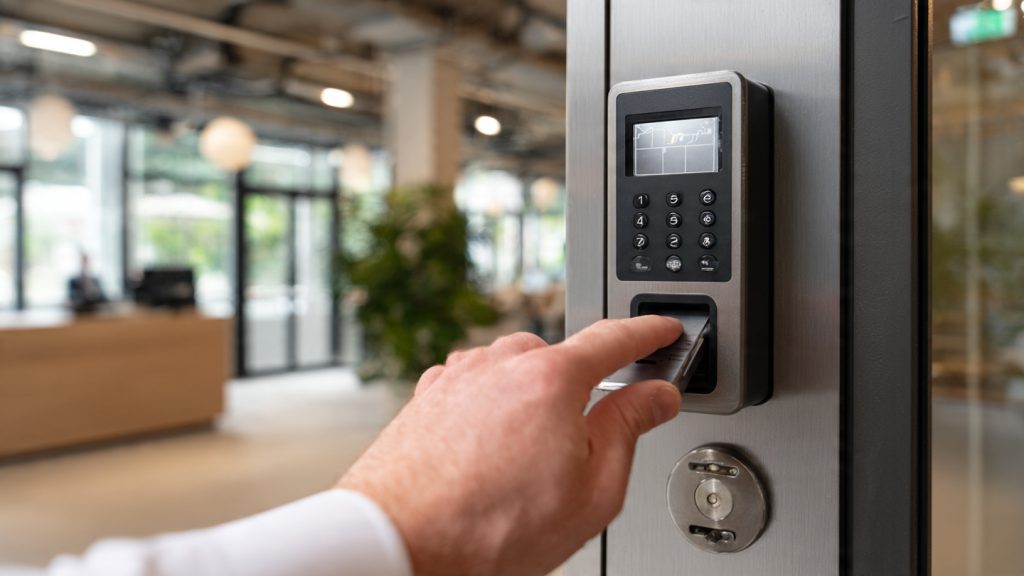
The “key” to modern access control is no longer a physical piece of metal but rather a digital credential. These credentials come in various forms, each with its own advantages and disadvantages.
Swipe Cards (Proximity Cards / Smart Cards)
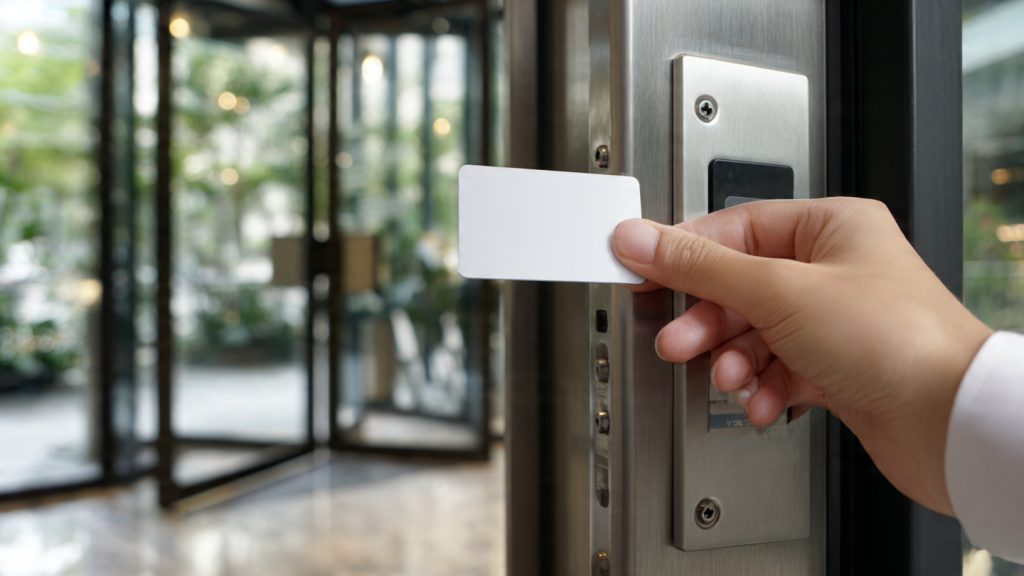
Swipe cards, often referred to as proximity cards or smart cards, are perhaps the most ubiquitous form of access control.
How Swipe Cards Work
- Proximity Cards (RFID): These cards contain a microchip and an antenna that communicate with a reader using radio-frequency identification (RFID) technology. When a card is brought within a certain range of a reader, the reader energizes the card via electromagnetic induction, allowing the card to transmit its unique identification number.
- Smart Cards (Contact/Contactless): Smart cards are more sophisticated, containing an embedded microprocessor and memory. Contact smart cards require physical insertion into a reader, while contactless smart cards operate similarly to proximity cards but often offer enhanced security features like encryption.
Advantages of Swipe Cards
- Cost-Effective: Often the most economical option for large deployments.
- Convenience: Easy to carry and use.
- Integrability: Can often be integrated with other systems, such as time and attendance tracking.
- Programmable: Cards can be programmed with specific access rights and invalidated if lost or stolen.
Disadvantages of Swipe Cards
- Vulnerability to Loss/Theft: If a card is lost or stolen, it can be used by an unauthorized individual until it is deactivated.
- “Card Tailgating”: An unauthorized person can follow an authorized person through an access point before it closes.
- Durability: Cards can be damaged or become unreadable over time.
- Security Concerns: Basic proximity cards offer limited encryption, making them potentially susceptible to cloning.
Keypads (PIN Entry)
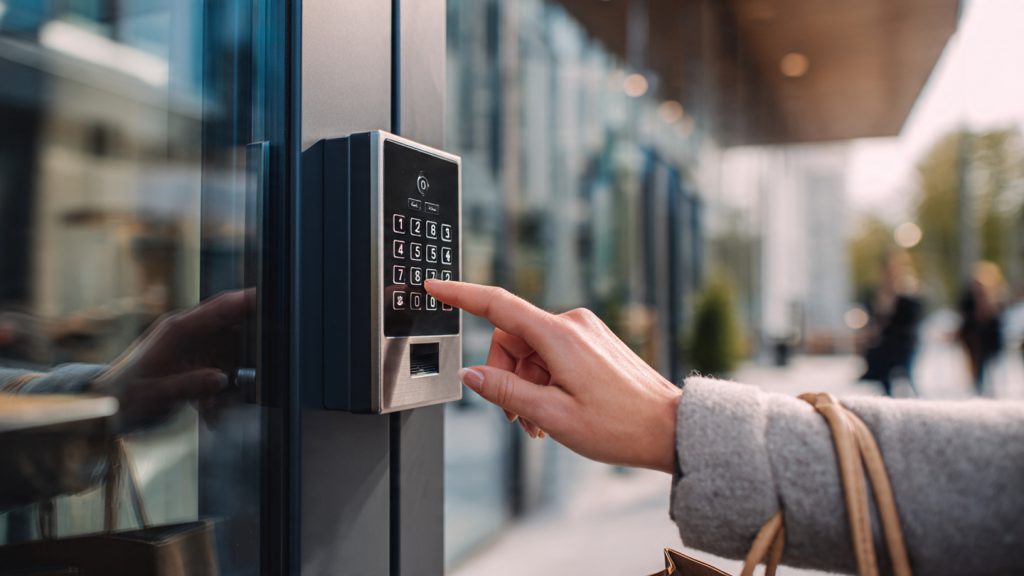
Keypad systems rely on a personal identification number (PIN) entered by the user to gain access.
How Keypads Work
Users input a predetermined numeric code into a keypad connected to the access control system. If the code matches an authorized PIN in the system’s database, access is granted.
Advantages of Keypads
- No Physical Credential Required: Eliminates the need for cards, reducing the risk of loss or theft of physical tokens.
- Cost-Effective: Generally less expensive to install than card-based or biometric systems.
- Simplicity: Easy to use for those familiar with numeric codes.
- Temporary Access: PINs can be easily generated and deleted for temporary visitors or contractors.
Disadvantages of Keypads
- “Shoulder Surfing”: PINs can be observed by unauthorized individuals.
- PIN Sharing: Users may share PINs, compromising security.
- Forgetting PINs: Users can forget their codes, leading to lockout situations.
- Limited Audit Trail: While the system logs successful entries, it doesn’t always identify the specific individual if PINs are shared.
Biometric Entry
Biometric systems leverage unique biological characteristics of individuals for identification and authentication. These are considered the most secure form of access control due to the inherent uniqueness of biometric data.
How Biometric Entry Works
- Enrollment: During enrollment, a user’s biometric data (e.g., fingerprint, facial features) is captured by a sensor and converted into a digital template. This template is securely stored in the system.
- Verification/Identification: When a user attempts to gain access, their biometric data is scanned again. This new scan is then compared to the stored template. If there is a sufficient match, access is granted.
Types of Biometric Readers
- Fingerprint Scanners: These are the most common biometric method, capturing unique patterns of ridges and valleys on a finger.
- Facial Recognition: Utilizes unique facial features and distances between them for identification. Advanced systems can even detect liveness to prevent spoofing with photographs.
- Iris Scanners: Analyze the unique patterns in the iris of the eye, offering high accuracy and security.
- Retinal Scanners: Scan the blood vessel patterns at the back of the eye, one of the most accurate but also most intrusive biometric methods.
- Voice Recognition: Identifies individuals based on unique vocal characteristics.
- Hand Geometry: Measures the shape and dimensions of a person’s hand.
Advantages of Biometric Entry
- High Security: Biometric traits are difficult to forge or replicate, offering a high level of security.
- Non-Transferable: Unlike cards or PINs, biometric data cannot be easily shared or stolen.
- Convenience: No need to carry cards or remember PINs.
- Strong Audit Trail: Directly links access events to a specific individual.
Disadvantages of Biometric Entry
- Higher Cost: Biometric systems are generally more expensive to implement than card-based or keypad systems.
- “False Positives” and “False Negatives”: Environmental factors, injuries, or changes in appearance can lead to incorrect matches.
- User Acceptance: Some individuals may have privacy concerns regarding the collection of biometric data.
- Enrollment Process: The initial enrollment process can be more involved.
- Physical Limitations: Scanners can be affected by dirt, moisture, or certain medical conditions.
Tailored Security Solutions in Sydney
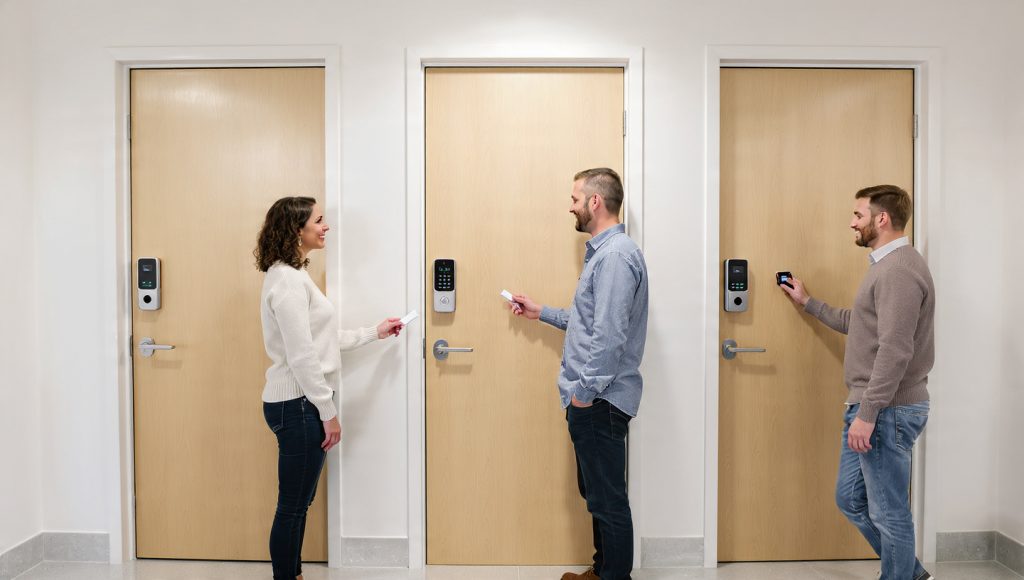
In Sydney, the demand for sophisticated and reliable access control systems is driven by a diverse range of security needs. Whether it’s securing a family home, safeguarding intellectual property in a commercial office, or ensuring the safety of large industrial complexes, the application of access control is constantly evolving.
Residential Security
We can help you keep trouble at bay. As licensed security solutions providers, we offer installation, programming, commissioning and maintenance of your home security system. From alarm systems through to CCTV and monitoring, we’re here to help you stay secure. For residential properties in Sydney, access control can manifest in various forms:
- Smart Locks with Keypad or Biometric Entry: Integrating keypads or fingerprint readers directly into door locks for convenient and keyless entry.
- Video Intercom Systems with Access Control: Allowing residents to visually identify visitors and grant access remotely through a smartphone or indoor unit.
- Gate Automation with RFID Tags: For homes with gates, RFID tags in vehicles can automate entry, providing convenience and security.
- Integration with Home Automation: Access control systems can be linked with smart home platforms to control lighting, HVAC, and other systems based on occupancy.
Commercial Security
Across the nation, security threats are increasing, and businesses are being targeted more often. As a leading commercial security business in Sydney, our team focuses on creating tailored, end-to-end security solutions designed to meet customer needs. Commercial environments require a more robust and scalable approach to access control:
- Multi-Factor Authentication: Combining different credential types (e.g., swipe card + PIN, or fingerprint + card) for enhanced security in sensitive areas.
- Time-Based Access Restrictions: Granting access to employees only during their working hours and restricting access to specific departments.
- Visitor Management Systems: Integrating access control with systems that register visitors, issue temporary credentials, and track their movements within the premises.
- Integration with Fire and Emergency Systems: In case of an emergency, access control systems can be programmed to automatically unlock doors for safe evacuation.
- Real-time Monitoring and Alerts: Security personnel can monitor access events in real-time and receive immediate alerts for unauthorized attempts.
- Scalability for Large Organizations: Systems designed to manage thousands of users and hundreds of access points across multiple buildings or locations.
For those interested in understanding the various types of security measures available, a related article can provide valuable insights into the latest advancements in access control technology. The piece titled “Access Control Systems Sydney: Swipe Cards, Keypads and Biometric Entry Explained Simply” delves into the functionalities and benefits of different entry methods. To explore more about these systems and how they can enhance security in various settings, you can read the full article here.
The Future of Access Control in Sydney
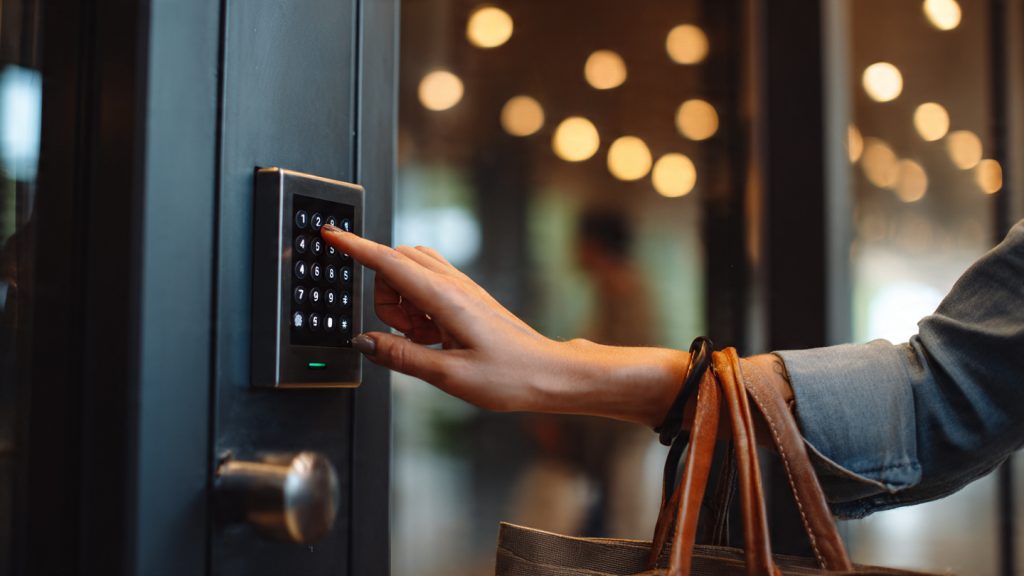
The landscape of access control is continuously evolving, driven by advancements in technology and increasing security demands. Several trends are shaping the future of these systems in Sydney and globally.
Mobile Access Control
Mobile access control leverages smartphones as credentials. Users can simply tap their phone against a compatible reader or use a dedicated app to unlock doors. This offers unparalleled convenience and eliminates the need for physical cards.
Cloud-Based Access Control
Cloud-based systems host the access control software and database remotely on secure servers. This offers several benefits:
- Remote Management: Administrators can manage the entire system from anywhere with an internet connection.
- Reduced Infrastructure Costs: No need for on-premise servers and associated maintenance.
- Automatic Updates: Software updates and security patches are automatically applied.
- Enhanced Scalability: Easily scales up or down based on organizational needs.
Artificial Intelligence (AI) and Machine Learning (ML)
AI and ML are beginning to play a significant role in enhancing access control systems:
- Anomaly Detection: AI can analyze access patterns and identify unusual behavior that may indicate a security breach.
- Predictive Security: ML algorithms can predict potential security risks based on historical data.
- Enhanced Biometrics: AI improves the accuracy and speed of biometric authentication, especially for facial recognition.
Blockchain for Access Control
While still in early stages, blockchain technology offers the potential for highly secure and decentralized access control. Its immutable and distributed ledger could provide tamper-proof records of access events and enhance data integrity.
Electrical Services: Powering Your Security
Whether you’re in the market to upgrade your family home, improve your commercial office building, build your dream home or have an emergency electrical concern and need immediate assistance, Alpha Security Corp has the right Master Electrician for you. It’s crucial to acknowledge that robust access control systems, especially those incorporating advanced biometrics and integrated security features, rely on a stable and well-maintained electrical infrastructure.
The Interdependence of Electrical and Security Systems
- Reliable Power Supply: Access control components like readers, controllers, and electric locks require continuous and reliable power. Any power fluctuations or outages can compromise the system’s effectiveness.
- Correct Wiring and Installation: Proper wiring, adhering to Australian standards, is paramount for the safe and efficient operation of all security equipment. Incorrect installation can lead to malfunctions, short circuits, or even fire hazards.
- Backup Power Solutions: For critical access points, uninterruptible power supplies (UPS) and backup generators are essential to ensure the access control system remains operational during power failures.
- Integration Challenges: When integrating access control with other building systems (e.g., fire alarms, CCTV), proper electrical planning and execution by qualified electricians are crucial to ensure seamless communication and functionality.
- Maintenance and Upgrades: Regular electrical maintenance ensures the longevity and optimal performance of the entire security infrastructure. Upgrading electrical systems may be necessary to support newer, more power-intensive access control technologies.
In conclusion, access control systems in Sydney are not merely about locking doors; they are sophisticated ecosystems designed to manage, monitor, and regulate entry into premises. From basic swipe cards to advanced biometric solutions, the technology offers unparalleled control and security. Understanding these systems is the first step towards implementing a robust security strategy that protects assets, personnel, and information, underpinned by reliable electrical infrastructure.