


Older homes in Sydney often have the features people love – solid construction, established streets, generous room sizes – and the exact infrastructure modern automation does not. That is why retrofit home automation Sydney projects succeed or fail long before the first keypad, sensor, or app is installed. The real work is designing a system that respects the existing building while upgrading how lighting, security, networking, audio visual, and control operate together.
A retrofit is not the same as a new build with open walls and unlimited cable paths. In an existing home, every decision has consequences. You may be working around finished plaster, heritage details, crowded switchboard space, old cabling, inconsistent Wi-Fi coverage, or rooms added at different times. The goal is not to force technology into the property. It is to build a practical system that feels native to the home and reliable enough for daily use.
What retrofit home automation in Sydney really involves
Many homeowners start by thinking about visible endpoints – smart lights, app control, motorized blinds, a video intercom, or security notifications. Those matter, but the backbone matters more. A professional retrofit usually begins with electrical capacity, structured cabling opportunities, network design, switchboard condition, and how each subsystem will communicate.
That matters because isolated smart devices tend to create isolated problems. A Wi-Fi doorbell from one brand, battery cameras from another, app-based lighting from a third, and consumer mesh networking added later may work individually, but they rarely behave like one coordinated system. The result is multiple apps, uneven performance, and a setup that becomes harder to maintain as the property evolves.
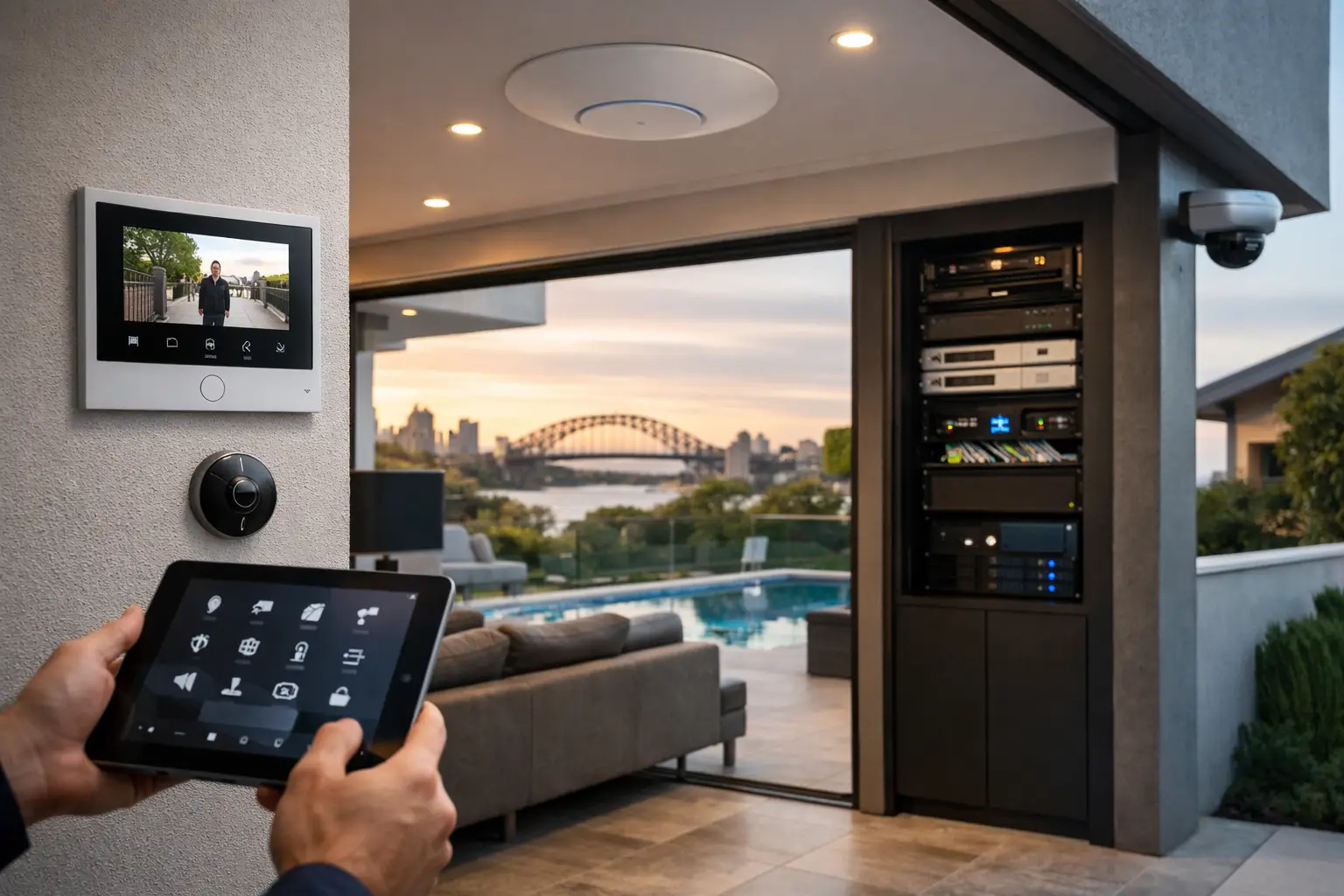
An integrated retrofit takes a different approach. Security, access, lighting, networking, and automation are designed as one environment. That may include Bosch alarms, Dahua or Hikvision CCTV, Akuvox intercoms, UniFi networking, DALI-2 lighting control with Zen Control, and higher-level integration through Apple Home or Home Assistant where it makes sense. The exact platform mix depends on the home, the client, and how much control depth is required.
Start with infrastructure, not gadgets
The fastest way to make a retrofit feel disappointing is to focus on devices before infrastructure. Strong automation depends on power quality, network stability, logical circuit design, and dependable communication between systems.
In practical terms, that often means reviewing whether the existing switchboard can support lighting control modules, whether there are sensible cable routes for cameras and access devices, and whether the home has the network coverage needed for mobile control, streaming, and connected services. In larger properties, weak Wi-Fi is not a minor inconvenience. It affects intercom reliability, app response, remote access, and the day-to-day trust people place in the whole system.
Structured cabling is still valuable in retrofit work, even when not every device can be hardwired. If key locations such as TV areas, wireless access points, intercom positions, CCTV cameras, and AV racks are planned properly, the system becomes more stable and much easier to support over time. Wireless has a role, but it should be part of the design, not a fallback for poor planning.
Lighting and control are where retrofits often need the most nuance
Lighting is usually the feature people notice first, but it is also where retrofit decisions get technical quickly. Not every existing circuit layout is suitable for advanced control. Some homes have switching arrangements that limit flexibility. Others have fittings that are incompatible with dimming methods or smart control hardware.
This is where a proper design process matters. In some homes, centralized lighting control with DALI-2 will be the right long-term answer, especially during major renovations or high-end upgrades. In others, a more selective approach makes more sense, improving key zones such as kitchens, living areas, outdoor spaces, hallways, and main bedroom suites without rebuilding every circuit in the house.
Good lighting automation is not about novelty scenes. It is about function. Entry paths that illuminate predictably at night, outdoor lighting tied to schedules and occupancy, bathroom and hallway lights that respond intelligently after hours, and all-off control that is simple when leaving the house. When these behaviors are planned around how people actually live, the system feels useful rather than performative.
Security should be part of the automation plan
A retrofit is the ideal time to stop treating security as a separate layer. Alarm systems, CCTV, intercoms, gates, door hardware, and lighting have natural points of integration, and they work better when considered together.
For example, an intercom event can trigger selected lighting, send mobile notifications, and provide camera verification. A perimeter alarm event can bring up relevant camera views. A night mode can confirm doors are secure, set the alarm, adjust lighting scenes, and reduce unnecessary energy use. These are not flashy automations. They are the practical benefits of systems designed to work as one.
In higher-end homes and complex residences, this integrated approach also improves usability for family members, guests, and staff. Instead of memorizing several apps or control methods, users get a simpler interface and more predictable behavior. That is usually what clients want most – not more technology, but less friction.
Apple Home, Home Assistant, and platform choice
When clients ask for control from an iPhone, iPad, or wall-mounted interface, the conversation should go beyond brand familiarity. Apple Home is excellent for clean user experience and everyday convenience. Home Assistant offers deeper customization, broader integration potential, and more sophisticated logic when the project demands it.
Neither platform is automatically right for every home. Apple Home works well where simplicity, family usability, and a polished mobile experience are priorities. Home Assistant becomes especially valuable when the property includes a broader mix of systems or requires custom workflows, detailed monitoring, and more flexible automation logic.
The key is not choosing a platform in isolation. It is making sure the underlying devices, network, electrical design, and user interface strategy support that platform properly. A good retrofit avoids the common mistake of promising advanced control on top of weak infrastructure.
Retrofit home automation Sydney homeowners should plan in stages
Not every retrofit needs to happen at once. In fact, staged delivery is often the smartest path, especially in occupied homes or properties undergoing partial renovation.
A staged approach might begin with switchboard upgrades, networking, and structured cabling. Then security and intercom can be added, followed by selected lighting control, AV, and deeper automation logic. This keeps disruption manageable while protecting the long-term design. It also helps avoid rework, which is where retrofit budgets often get wasted.
That said, staging only works if there is a master plan from the beginning. Installing components one trade at a time without an integration strategy usually creates incompatibility later. Electricians, security contractors, AV installers, and network providers can all do competent work individually, but if no one is coordinating the full system architecture, the property ends up with fragmented technology.
What makes a retrofit successful in real homes
The best retrofit projects are rarely the ones with the most features. They are the ones where the system is stable, intuitive, and suited to the building. That means balancing ambition with constraints.
Some homes justify extensive rewiring and centralized control. Others benefit more from targeted upgrades built around strong networking, reliable security, and carefully selected automation zones. Heritage homes may need more discreet hardware choices and more creative cable paths. Larger family homes may prioritize access control, perimeter awareness, and dependable Wi-Fi before advanced scene control. There is no single formula, and that is exactly why design matters.
For property owners in Sydney, local experience also has practical value. Housing stock varies widely across the city, from older brick homes and renovated terraces to architect-designed residences and strata environments with their own limitations. A retrofit plan that looks good on paper still needs to work with the realities of the site.
Alpha Security Corp approaches this kind of work as a full-system integration problem, not a device shopping exercise. That matters because homes perform better when security, electrical, networking, lighting, and control are planned together from the outset.
A well-designed retrofit should feel calm. The lights respond as expected. The cameras and alarms are easy to manage. The Wi-Fi holds up. The intercom is clear. The control system makes everyday routines easier without demanding attention. That is the benchmark worth aiming for – technology that quietly earns its place in the home.