


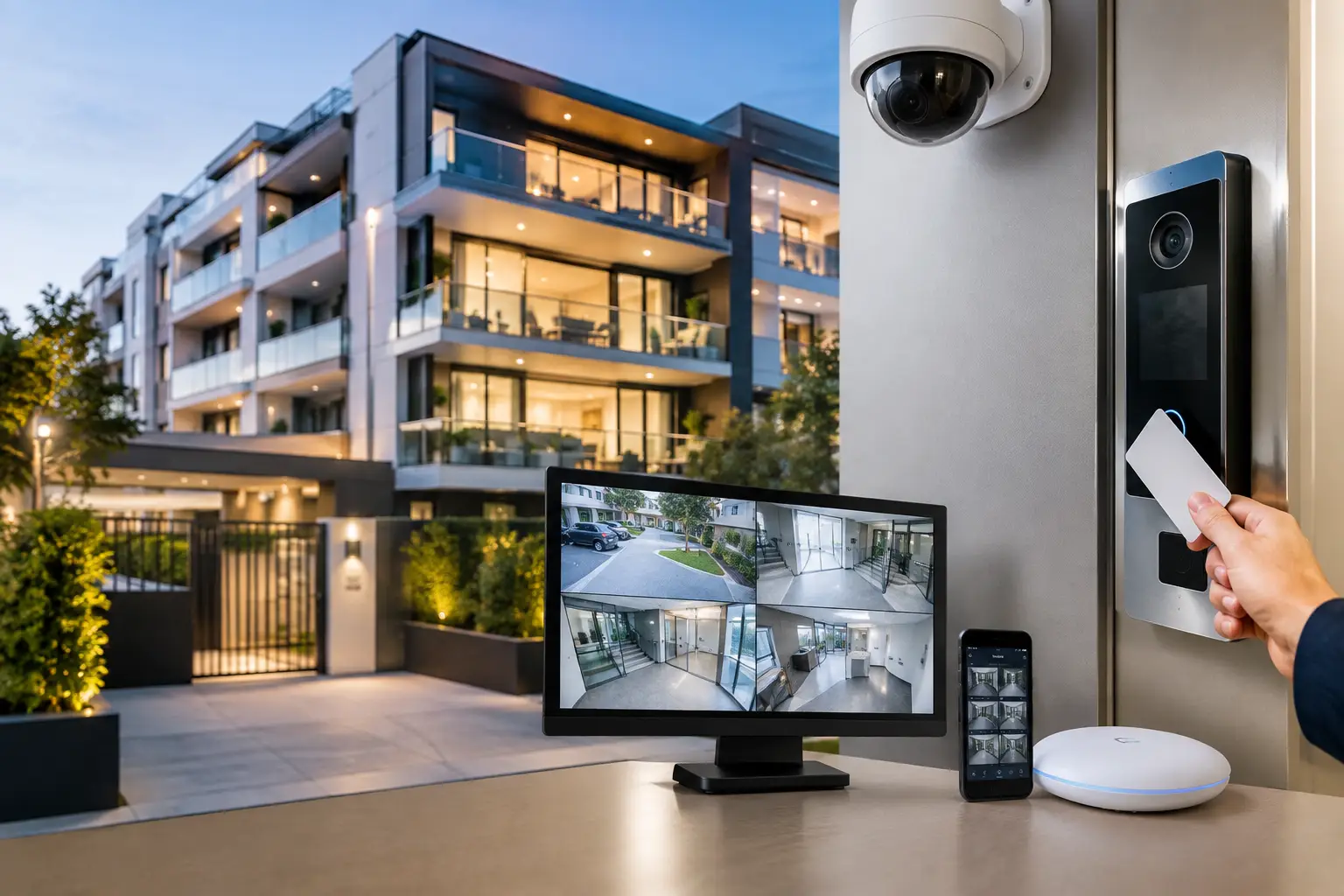
A compromised garage door, a delivery left in an unsecured lobby, or a resident’s lost access fob can affect an entire building rather than one household. That is why the top security upgrades strata committees consider should be planned as a connected property system, not a collection of separate devices. The right design improves resident safety, gives managers clearer oversight, and makes daily access easier without creating a burden for the people who live and work there.
For established buildings, the challenge is usually integration. Equipment may have been installed in stages over many years: an aging intercom at the entrance, standalone cameras, multiple key systems, unreliable Wi-Fi, and no clear record of who can access common areas. A practical upgrade brings these components into a reliable framework that can be maintained and expanded over time.
Start With the Building’s Actual Risk Points
A good strata security plan begins with a site assessment, not a product list. Review how people enter the property, where they move once inside, and which areas are vulnerable to unauthorized access. Main entries, side gates, parking garages, lift lobbies, mailrooms, storage cages, plant rooms, rooftop areas, and waste rooms each create different risks.
The goal is not to put a camera on every wall. It is to establish clear, useful coverage and controlled access at the points that matter most. For example, a garage may need credential-based entry, camera coverage of the vehicle entrance and pedestrian door, adequate lighting, and a reliable network connection. Installing only a camera may record an incident, but it does not reduce the opportunity for it to happen.
Committees should also consider operational realities. A building with frequent contractors needs a different access model from a quiet owner-occupied complex. A mixed-use site with commercial tenancies requires separation between residential and business areas. The best design reflects these patterns rather than forcing every property into the same template.
Access Control Is Usually the Highest-Value Upgrade
Traditional keys are difficult to manage at scale. Copies can be made without approval, lost keys may require costly rekeying, and there is often no reliable record of who still has access. Electronic access control gives strata managers more control over common-area doors, garages, gates, amenities, and sensitive service spaces.
Residents can use fobs, cards, mobile credentials, or a combination of methods depending on the building’s needs. When a credential is lost or a tenancy changes, access can be removed without replacing locks across the property. Administrators can also set permissions by door, user group, or schedule. A cleaner may need access to specific areas during approved hours, while a contractor can receive limited access that expires after a project is complete.
The hardware selection matters. Exterior doors, fire-rated doors, gates, and high-traffic entry points require suitable locks, door hardware, power supplies, and compliant egress arrangements. Access control should never compromise life safety or emergency exit requirements. This is where security design and licensed electrical capability need to work together from the outset.
For larger sites, access control can also provide useful audit trails. These records do not replace good building management, but they can help clarify when a common door was used and support a more accountable operating environment.
Replace Fragmented Intercoms With Managed Visitor Entry
An intercom is often the first security touchpoint for a visitor, delivery driver, or contractor. Older systems can be difficult to service, limited to a single handset, and dependent on aging building cabling. Modern video intercom platforms, including systems from Akuvox, can provide clear visitor communication, visual verification, directory management, and remote release where appropriate.
The strongest intercom installations are designed around resident convenience as well as security. Residents should be able to answer visitors through reliable indoor stations or approved mobile workflows, while building management retains control over the directory and entry settings. For some buildings, a simple video panel at the main entrance is sufficient. Others may need multiple entry stations, separate loading access, lift integration, or controlled visitor paths.
Remote door release needs careful configuration. It can be highly useful for residents expecting a guest or service provider, but it should not become an informal way to open the building to unknown callers. Clear resident guidance and well-positioned cameras around entry points help maintain the intended security benefit.
Use AI CCTV for Useful Evidence, Not Camera Count
CCTV remains one of the most effective upgrades for common areas, but only when footage is clear, coverage is purposeful, and recordings are accessible when needed. A poorly placed camera that cannot identify a person at the relevant distance offers limited value, regardless of its resolution.
Modern AI-enabled CCTV platforms from manufacturers such as Dahua and Hikvision can help distinguish people and vehicles from general motion. This reduces nuisance alerts caused by shadows, rain, trees, or passing animals. It also makes incident review faster when managers need to find activity at a gate, lobby, or garage entrance within a specific time window.
Camera placement should prioritize entry and exit points, vehicle approaches, lobbies, mailrooms, elevators where permitted and appropriate, and other shared spaces with a genuine security purpose. Lighting conditions matter just as much as camera specifications. Backlit glass entries, dark garages, and poorly lit side paths require design attention if footage is expected to be usable at night.
Strata committees should establish sensible privacy and retention settings before installation. Cameras should protect common property, not unnecessarily intrude on private living areas. Access to recordings should be limited to authorized personnel, with clear procedures for reviewing and exporting footage after an incident. Good governance protects residents and supports the integrity of the system.
Build the Network and Cabling Behind the Security System
Security systems are only as dependable as the infrastructure supporting them. An IP camera, video intercom, access-controlled door, and remote management platform all rely on stable power and network connectivity. Relying on consumer-grade wireless equipment in concrete buildings, garages, or large common areas can introduce avoidable failures.
Structured cabling and properly planned network equipment provide the foundation for reliable operation. A UniFi-based network, for example, can give authorized administrators visibility over device health, network segmentation, and connection performance. Security devices should generally sit on dedicated network segments rather than sharing unrestricted access with resident or guest networks.
This is also a long-term planning decision. When cabling pathways, communications cabinets, power requirements, and network capacity are considered together, future additions become simpler. The building can add cameras, intercom locations, access doors, or smart common-area lighting without rebuilding the underlying system each time.
Cybersecurity deserves equal attention. Default passwords, outdated firmware, exposed remote access, and unmanaged devices can undermine an otherwise well-designed installation. Use professionally configured credentials, controlled administrator access, regular updates, and secure remote-management practices. A connected security system should be treated as operational infrastructure, not as a set-and-forget appliance.
Improve Visibility With Lighting and Alarm Integration
Security lighting is most effective when it supports both surveillance and safe movement. Dimly lit pedestrian paths, parking areas, and entry approaches create blind spots for cameras and discomfort for residents. Well-designed lighting improves image quality while making common spaces more usable.
For suitable properties, lighting controls can be integrated with access events, schedules, or alarm conditions. A side path may operate at a low overnight level and brighten when authorized access is detected. A garage door event can trigger lighting around a pedestrian entry. These are practical automations, not novelty features, and they should always preserve manual control and predictable operation.
Alarm monitoring may also be appropriate for higher-risk common areas such as management offices, equipment rooms, storage zones, or commercial components of a mixed-use property. The right approach depends on the site, its operating hours, and how quickly an event needs to be acted upon. Cameras, alarms, access control, and lighting work best when their roles are clearly defined rather than duplicated without purpose.
Plan Top Security Upgrades for Strata as One System
The most common mistake in strata security is solving each issue in isolation. A committee installs a gate camera after one incident, changes locks after another, then replaces an intercom when it fails. Over time, the building accumulates multiple apps, incompatible hardware, unclear responsibilities, and rising service complexity.
A staged plan is often more realistic than replacing everything at once. Start with the highest-risk entry points and the infrastructure needed to support future work. Then sequence access control, intercom, CCTV, networking, and lighting upgrades around budget cycles and building projects. Document the system, retain administrator credentials securely, and ensure the committee has a clear maintenance pathway.
For strata properties in Sydney and across NSW, Alpha Security Corp designs integrated systems that combine security, electrical, networking, and automation expertise in one practical scope. The objective is not to add technology for its own sake. It is to give the building a security environment that residents can use confidently and managers can operate reliably.
The most helpful next step is to walk the property as residents, visitors, and contractors do. The gaps become clearer when you follow the route from the street to the front door, garage, elevator, and shared spaces. That real-world view is where a security upgrade plan starts to become useful.