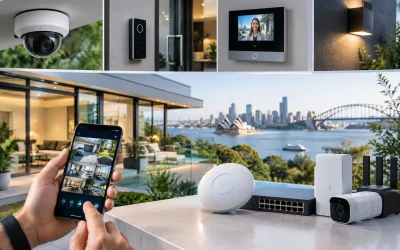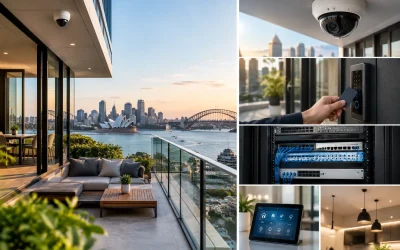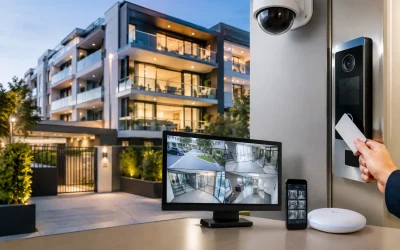



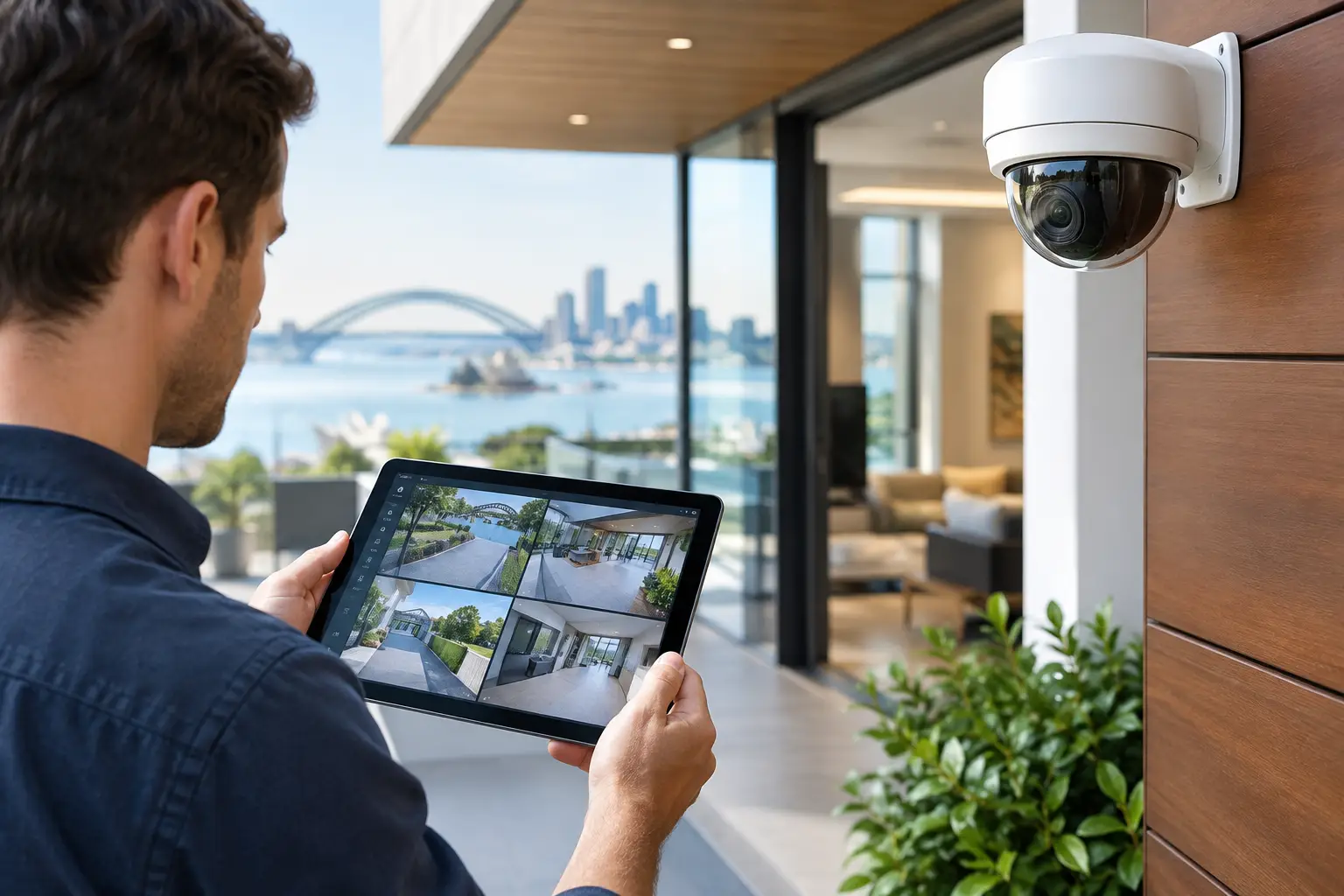
A camera that sends an alert every time rain moves a tree branch is not making a property safer. It is teaching staff to ignore alerts. To choose AI CCTV analytics well, start with the operational decision each alert should support: investigate an intrusion, manage a restricted area, verify a delivery, find a person, or understand site activity. The right system reduces attention where nothing matters and provides usable evidence when something does.
For homes, commercial premises, strata properties, warehouses, and education or healthcare sites, analytics should be part of a planned security design. Camera positioning, lighting, recording capacity, network performance, access control, and response procedures all influence whether an analytic delivers value. Selecting a feature from a camera specification sheet is not the same as designing a dependable security outcome.
Choose AI CCTV Analytics Around Real Site Risks
The first question is not which analytic is most advanced. It is where risk, delay, or uncertainty currently exists on the property.
A residential client may need reliable alerts when a person approaches a side gate after hours, while ignoring pets and street traffic. A warehouse may need a virtual line across a loading-bay boundary, with different rules during operating hours and overnight. A strata manager may be focused on unauthorized access to plant rooms, illegal dumping, or recurring incidents around entry points. These are different problems, and they call for different camera views, rules, and response paths.
Define the event in clear terms: who or what should be detected, where it can appear, when it matters, and what should happen next. A rule such as “detect vehicles” is too broad. “Notify the duty manager if a vehicle enters the rear service lane between 9 p.m. and 5 a.m.” is measurable and can be tested.
This approach also keeps expectations realistic. AI video analytics can identify defined events within a well-designed scene. They do not replace security procedures, a monitored alarm, secure doors, adequate lighting, or human judgment. They make those systems more informed.
Start With the Camera View, Not the Analytics Menu
AI depends on usable image information. If a face, vehicle, or person is too small in frame, heavily backlit, obscured by glare, or outside the camera’s effective night performance, an advanced analytic cannot reliably compensate.
Before specifying intrusion detection, people counting, license plate capture, or object classification, assess the scene. Consider mounting height, angle, focal length, distance to the target, changing sunlight, reflective surfaces, headlight glare, and nighttime illumination. An overview camera is valuable for context, but it may not deliver the pixel detail needed to identify a person at the far end of a driveway or read a plate at a gate.
A practical design often uses more than one view. A wide camera can establish movement and direction, while a tighter, purpose-positioned camera supports identification at a critical entrance or vehicle lane. For license plate recognition, the camera typically needs a controlled approach angle, appropriate shutter settings, and suitable lighting. Treating it like a general parking-lot camera often produces inconsistent results.
Existing cameras may support basic analytic functions, but compatibility should be verified rather than assumed. The recorder, camera firmware, licensing model, processing location, and manufacturer platform all affect the features available. A professionally assessed upgrade may retain useful infrastructure while replacing the cameras that limit performance.
Edge, Recorder, or Cloud Processing?
Analytics can run at the camera edge, on a network video recorder, on a server, or through a cloud platform. Each approach has a place.
Edge analytics can respond quickly and reduce unnecessary video traffic because the camera classifies events locally. Recorder-based analytics can centralize management across compatible cameras and may suit sites where local recording is preferred. Cloud analytics can offer flexible access and ongoing feature development, but it introduces internet dependency, subscription considerations, and a need to understand where video and metadata are stored.
The right answer depends on the site’s connectivity, retention requirements, cyber security controls, number of cameras, and the organization’s tolerance for recurring costs. For a property with reliable structured cabling and a properly segmented UniFi network, local processing and recording can provide strong performance without making every event dependent on an external connection. For distributed locations, centrally managed cloud services may be more practical.
Prioritize Alerts That People Will Act On
The most valuable analytics are often the least dramatic. Person and vehicle classification, line crossing, intrusion zones, loitering, and object detection can significantly reduce nuisance notifications compared with basic motion detection.
However, every rule needs careful tuning. A line-crossing alert near a public sidewalk will be noisy unless the field of view and rule direction are tightly controlled. Loitering detection can be useful around a commercial entrance after hours, but it may be unsuitable in a shared residential foyer where people naturally wait for visitors. Object-left-behind alerts can help in controlled environments, yet busy public areas may create too many ambiguous events.
Use schedules, object filters, directional rules, and exclusion zones to reflect how the property operates. A delivery entrance may allow vehicle movement during business hours but generate an alert overnight. A pool gate may trigger on people at all times, while a garden path rule ignores animals. The target is not maximum alerts. It is a small number of alerts that have a clear response owner.
A sensible commissioning process includes testing the rules under real conditions: daylight, darkness, rain, busy periods, and quiet periods. It should also include a review after the first weeks of use. Analytic settings are operational controls, not a one-time configuration item.
Match the Platform to Your Security Workflow
When you choose AI CCTV analytics, consider what happens after detection. A notification on a phone may suit a homeowner who wants to check a live view. A commercial site may need alerts sent to a control room, security manager, or back-to-base monitoring workflow. A strata property may need selected incidents packaged for a manager or committee without granting broad access to all residents.
The video management platform should make it easy to search, verify, export, and audit events. AI metadata can speed up investigations by allowing operators to search for a person, vehicle type, color, direction of travel, or a time-based event rather than manually reviewing hours of footage. That benefit matters most when the system is organized around the way staff actually investigate incidents.
Integration is equally important. CCTV can work alongside access control, intercoms, alarms, and lighting to provide more context. For example, an access event at a staff door can call up the relevant camera view. An alarm activation can prioritize video from the affected zone. Exterior lighting may be programmed to support safer verification where appropriate, while preserving the site’s operating rules and neighbor considerations.
Not every integration should be automated. Automatically opening a gate or disarming an area based only on video classification can introduce unnecessary risk. A better design often uses analytics to inform a verified decision, particularly at commercial sites and shared properties.
Check Network, Storage, and Cyber Security Early
AI analytics place real demands on the underlying system. Higher-resolution cameras, continuous recording, remote viewing, and event clips all affect bandwidth and storage. A weak wireless link or overloaded consumer-grade network can turn a well-selected camera system into an unreliable experience.
For new builds and major renovations, structured cabling should be planned to each camera location, recorder position, network rack, intercom, access-control point, and wireless access point. Power over Ethernet simplifies deployment and allows centrally managed network equipment to support cameras more reliably than ad hoc power supplies. On larger sites, VLAN segmentation can separate cameras and security devices from general business or resident networks.
Storage should be based on actual requirements rather than a generic number of days. Recording resolution, frame rate, compression, scene activity, camera count, retention policy, and whether recording is continuous or event-based all affect capacity. Critical entrances may justify continuous high-quality recording, while lower-risk areas may use event recording with carefully configured pre-event capture.
Cyber security is part of physical security. Use unique credentials, managed user permissions, current firmware, protected remote access, and an installer who can document ownership and administration of the system. Avoid platforms that require broad, permanent access without a clear support arrangement.
Build Privacy Into the Design
Analytics can improve security while creating legitimate privacy responsibilities. Camera placement should be limited to the purpose of the system, and access to footage should be role-based. For workplaces, shared residential spaces, healthcare settings, and education environments, stakeholders should understand what is being recorded, how long it is retained, and who can retrieve it.
Privacy masking can block neighboring properties, private windows, keypads, or other areas that should not be recorded. It is also worth distinguishing between detection and identification. A system may need to detect a person entering a restricted corridor without capturing unnecessary detail from adjacent public or private spaces.
For any site, establish a practical policy for footage requests, exports, retention, and incident review. The best technical design can still fail operationally if nobody knows who is authorized to access evidence or how it should be handled.
A Practical Evaluation Before You Commit
When comparing AI CCTV options, ask an installer to demonstrate analytics in a scene similar to your site and explain the limits as clearly as the capabilities. A useful evaluation covers five areas:
- The event types that matter and the expected false-alert risks.
- The camera positions, lighting conditions, and identification distances required.
- Where analytics and recordings are processed, stored, and managed.
- How the system connects with alarms, access control, intercoms, and monitoring.
- The ongoing plan for firmware, testing, user access, maintenance, and support.
This conversation reveals whether a proposal is based on an integrated design or simply a collection of devices with AI labels. Platforms from established security manufacturers can provide strong analytic capability, but the result depends on correct specification, installation, commissioning, and ongoing management.
The most effective AI CCTV system is usually the one that quietly gives the right person the right evidence at the right time. Start with a specific site decision, design the camera view and network to support it, then let analytics do the focused work they are meant to do.