


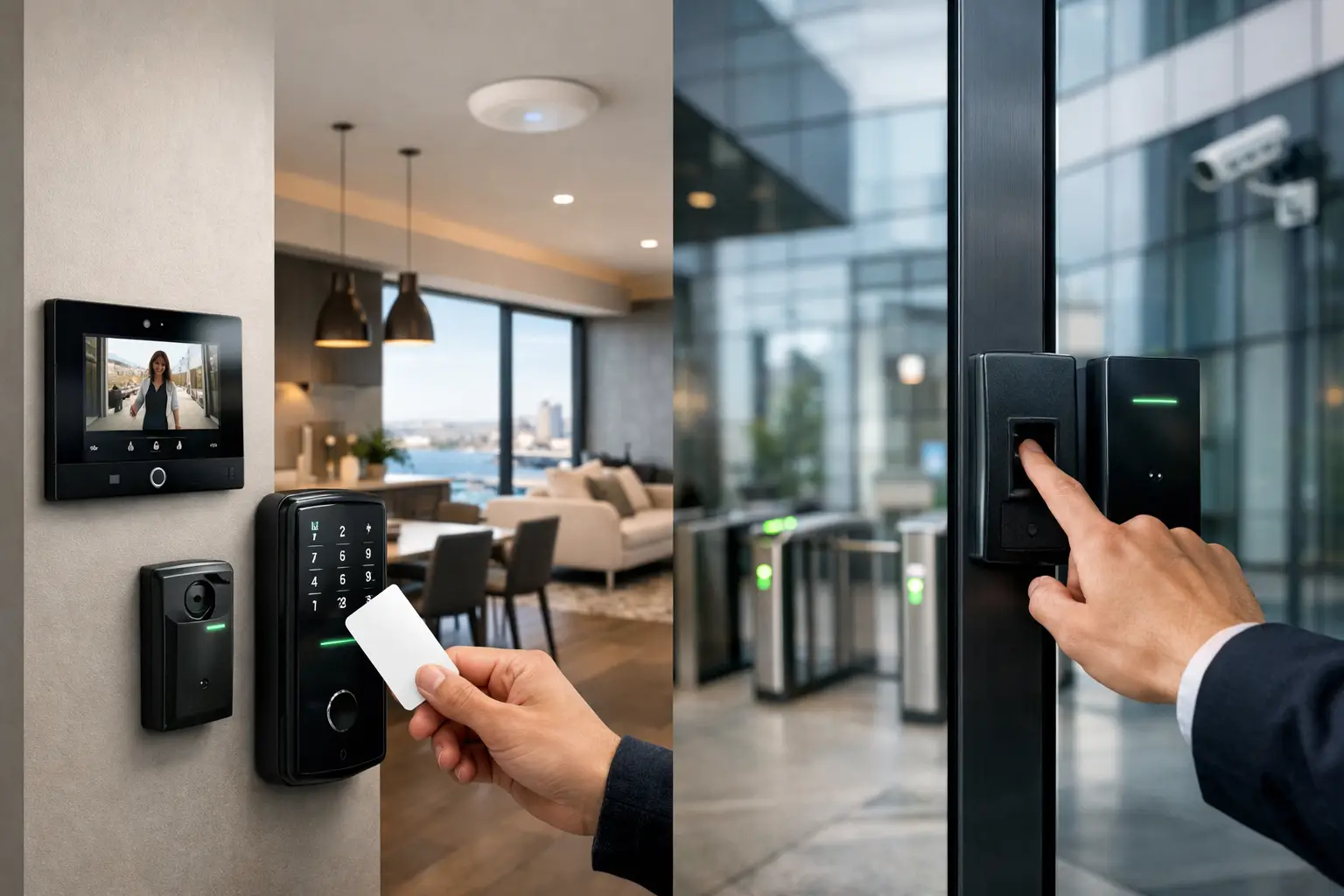
A door credential is no longer just a key replacement. It is becoming part of a property’s wider operating system – connected to intercoms, alarms, video, networks, lighting, visitor management, and the people responsible for the building. The most meaningful access control trends 2026 are therefore less about adding a reader to a door and more about designing a reliable identity layer around the property.
For business owners, strata committees, builders, and homeowners, that distinction matters. A system that looks advanced at installation can become difficult to administer if cabling, network capacity, door hardware, backup power, and integration requirements were treated as separate decisions. The strongest access control projects begin with how people actually use the site, then build the physical and digital infrastructure to support it.
Access control trends 2026 are moving beyond the door
Access control has traditionally been assessed by a simple question: who can enter a particular area? That question still matters, but properties now need more context. Who requested access? Was a visitor verified through an intercom? Did a door remain open? Should a forced-door event bring up the relevant camera? Does a contractor’s credential expire automatically after a scheduled job?
The shift is toward systems that provide usable operational information rather than a standalone audit trail. In a commercial setting, this can reduce the time spent reviewing incidents and managing staff changes. In a premium residence or multi-dwelling building, it can make guest entry, deliveries, gates, and internal access easier to manage without weakening control.
This does not mean every opening needs the same technology. A server room, a shared lobby, a warehouse roller door, and a private side gate each have different risk, traffic, privacy, and safety requirements. Good design applies more control where it is justified and keeps routine entry straightforward where it is not.
Mobile credentials become a practical default
Mobile credentials are expected to feature prominently in new access control deployments through 2026. They let an authorized person use a smartphone or wearable device instead of relying solely on a physical fob or card. For organizations with changing staff, contractors, or multiple sites, the administrative benefit is clear: credentials can be issued, amended, and revoked without collecting and reprogramming every physical token.
The advantage is not that phones are inherently better than cards. It is that they can fit into a more flexible identity process. A new employee can receive access before their first day. A temporary credential can be limited by date, time, or entry point. A lost phone can be removed from the system quickly, while a replacement device is activated.
Physical credentials will remain relevant, particularly for sites with safety requirements, users who do not carry compatible smartphones, or environments where a simple card is the most dependable option. Many well-planned systems will use both. The key is to select readers and controllers that support a staged transition rather than forcing every user into one method on day one.
Frictionless entry still needs clear controls
Convenience can create blind spots when it is implemented without rules. Mobile access should be supported by sound enrollment procedures, device security expectations, permission reviews, and a clear process for lost devices. For sensitive areas, a mobile credential alone may not be sufficient. A PIN, second credential, or approval workflow may be appropriate.
For residential projects, the same principle applies to family members, cleaners, tradespeople, and short-term guests. Entry should feel simple for trusted users, while the owner retains a clear view of who can access gates, garages, service areas, and the home itself.
Video intercom and access control will be planned together
The front door is increasingly a decision point rather than a simple buzzer. Modern intercom platforms can combine video calling, remote release, directory functions, and mobile notifications, creating a more informed visitor experience. Platforms such as Akuvox are often used where a property needs professional intercom capability that can sit alongside access control rather than operate as an isolated device.
The useful integration is contextual. When a visitor calls, the occupant or receptionist should be able to see and speak with them before granting entry. When an access event requires investigation, the relevant camera view should be available without searching through unrelated footage. At larger sites, reception, security, and building management teams may need different permissions and views.
There are practical limits. Remote door release depends on reliable network design, power continuity, and careful configuration. It should not be treated as a substitute for appropriate locks, door closers, fire egress provisions, or physical perimeter design. The door hardware and life-safety requirements remain the foundation.
AI video adds context, not automatic certainty
AI-assisted CCTV is making access events easier to interpret. A camera can help distinguish ordinary movement from a person loitering at a restricted entry, a vehicle arriving after hours, or activity around a door that has been held open. When designed correctly, this gives teams a faster path from an event notification to useful evidence.
The word “AI” deserves caution. Detection accuracy varies with camera placement, lighting, scene complexity, weather, and the analytics selected. A poorly positioned camera will not become reliable because its software has advanced. Camera coverage, lens choice, lighting, recording retention, and network capacity still require careful design.
The better approach is to use analytics to prioritize attention. A forced-door signal paired with a camera bookmark is more useful than a flood of generic motion alerts. Dahua, Hikvision, and Bosch platforms each offer different capabilities and deployment considerations, but the outcome should be the same: operators receive meaningful information without being overwhelmed by notifications.
Network and power infrastructure become access control priorities
As readers, controllers, intercoms, cameras, and mobile management platforms become more connected, network architecture is no longer a background consideration. It directly affects availability, cybersecurity, maintenance, and future expansion.
A professionally designed system should account for structured cabling pathways, equipment locations, PoE capacity where relevant, controller communication, network segmentation, remote support, and backup power. UniFi networking can provide a strong management foundation for many properties, but the important decision is not the logo on the network equipment. It is whether the network has been designed to support critical building systems separately and reliably.
Access control should also have a defined response to an internet outage. Local operation, controller behavior, credential validation, event storage, and remote-management limitations all need to be understood before installation. Cloud management can be valuable, especially across multiple sites, but critical doors should not become unusable simply because an external connection is interrupted.
Cybersecurity becomes part of physical security
Connected access systems require disciplined administration. Default credentials, unmanaged user accounts, outdated firmware, open remote access, and shared administrator logins all create avoidable exposure. The same principles used for business networks apply here: least-privilege access, unique accounts, regular updates, secure remote access, and documented ownership of the system.
For strata and commercial sites, this also means planning for handover. Building managers change, tenants move, and service providers are replaced. The property owner should retain clear control of administrator access, documentation, licenses, and system records rather than being dependent on an individual device or person.
Access data will support operations, not just investigations
Access event history is becoming more useful when it is aligned with building operations. Facilities teams can identify recurring door faults, repeated after-hours entries, doors that are routinely propped open, or credentials that no longer match a person’s role. This can support maintenance planning as well as security reviews.
The trade-off is privacy. Not every property needs detailed reporting, and not every stakeholder should see the same information. Employers, strata committees, and property managers should establish sensible retention periods, user permissions, and policies that reflect the purpose of the system. Collecting more data than a site can responsibly manage does not improve security.
Flexible systems are more valuable than fashionable systems
The 2026 access control market will continue to produce new readers, apps, cloud platforms, and analytics features. Some will be useful. Others may add cost and complexity without improving daily operation. The most durable investment is a system with strong fundamentals: correctly specified door hardware, secure cabling, reliable power, sensible network design, clear user administration, and integration points that serve a real use case.
For a new build, this is the time to coordinate access control with electrical, structured cabling, CCTV, intercoms, gates, and smart lighting before walls are closed. For a retrofit, the priority may be selecting components that work with existing doors and pathways while leaving room to expand. In either case, a cohesive design prevents the common outcome of several disconnected apps, credentials, and service providers.
A well-designed access system should become less noticeable over time. People enter where they should, visitors are handled with confidence, events can be investigated quickly, and the property remains ready for the next tenant, staff member, renovation, or security requirement.