


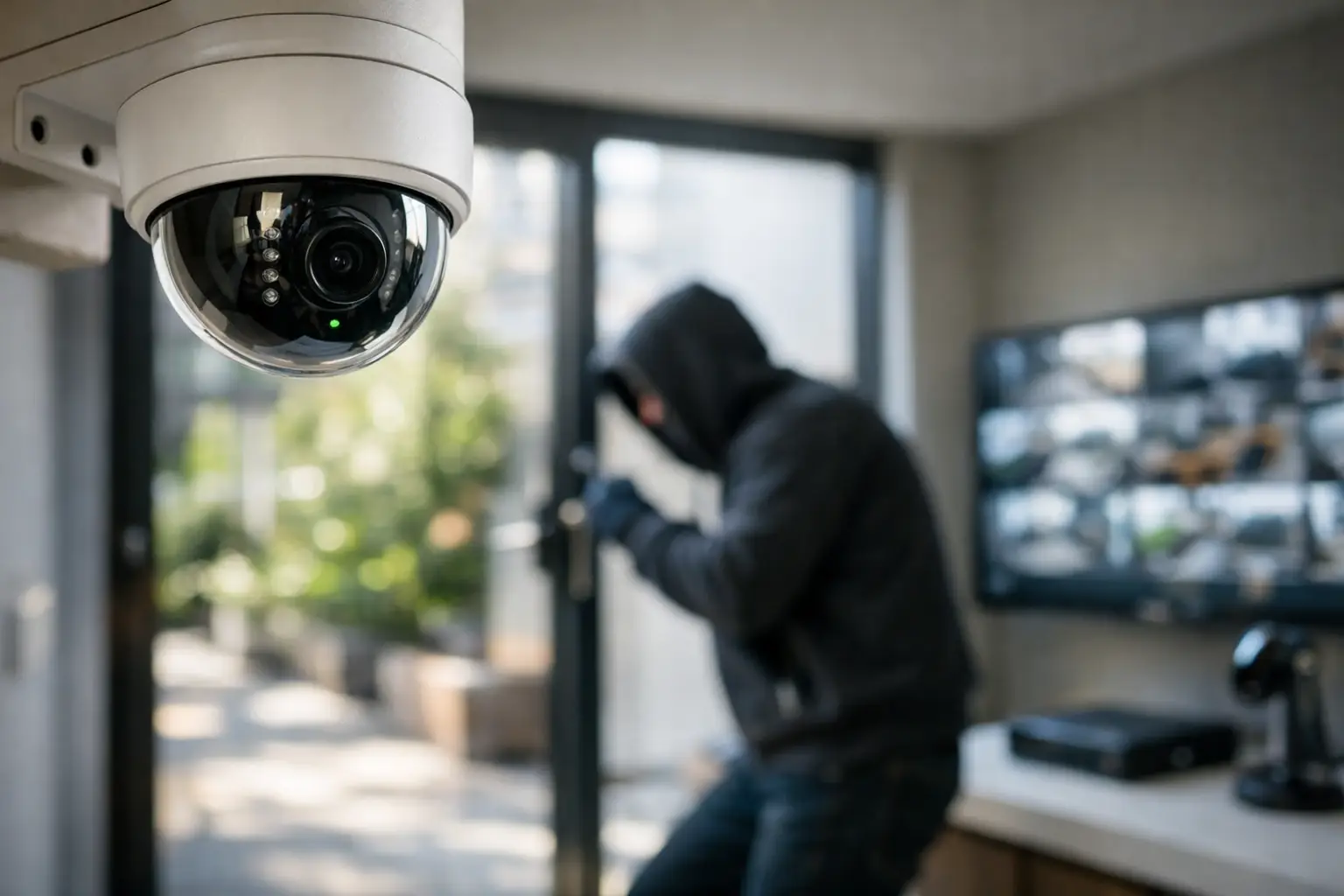
A camera that records a theft after the fact has value, but it does not prevent the immediate loss. The better question is: can AI CCTV reduce theft by identifying suspicious activity early enough for someone, or another system, to respond? In many residential, retail, warehouse, and commercial settings, the answer is yes – provided the camera system is properly designed, commissioned, and connected to a practical response plan.
AI CCTV is not a replacement for physical security, access control, alarms, lighting, or good site procedures. It is a way to make those systems more aware of what is happening. Rather than asking a person to review hours of footage or react to every moving tree branch, intelligent video analytics can focus attention on people, vehicles, objects, and behaviors that matter.
Can AI CCTV Reduce Theft? It Depends on the Response
The strongest theft reduction comes from increasing the perceived risk of being detected while reducing the time between an incident and a response. A visible, professionally installed CCTV system can act as a deterrent on its own. AI analytics add another layer by filtering video events so security staff, managers, or monitoring teams receive more relevant alerts.
For example, a camera at a warehouse loading area can distinguish a person entering a restricted zone after hours from ordinary movement caused by rain, headlights, or vegetation. A retail camera may identify people lingering near a staff-only door or detect an object removed from a designated area. At a residential property, analytics can classify a person approaching a side gate while ignoring pets and passing vehicles.
That distinction matters because excessive false alerts eventually lead to ignored notifications. A system that sends useful alerts is far more likely to trigger action, whether that means checking live video, activating lighting, issuing an audio warning, dispatching a patrol, or preserving evidence for an investigation.
AI CCTV does not guarantee that theft will not occur. An offender may act quickly, conceal their identity, exploit an unsecured entry point, or target an area outside camera coverage. The technology is most effective when it supports a layered security design rather than being treated as a standalone answer.
What Intelligent Video Analytics Actually Do
Modern cameras and video recorders from established platforms such as Bosch, Dahua, and Hikvision can use analytics to recognize defined event types. The exact functions vary by model and system, but useful applications commonly include person and vehicle classification, line crossing, intrusion zones, loitering detection, people counting, object left behind or removed, and license plate recognition where conditions support it.
A line-crossing rule, for instance, can be configured for a gate, loading dock, stockyard boundary, or restricted hallway. The camera does not simply report motion. It reports a person or vehicle crossing that virtual line during the times and in the direction you specify. This is a more meaningful event than a conventional motion alert.
Object-based analytics can also support investigations and operational control. If equipment is removed from a monitored storage bay, an alert can provide the relevant video clip and timestamp. In a commercial environment, this can help establish patterns, identify recurring vulnerabilities, and give managers usable information instead of a large archive of unreviewed recordings.
Accuracy depends heavily on camera placement, lighting, lens selection, scene complexity, and configuration. A wide camera mounted too high may provide broad awareness but insufficient detail to identify faces, clothing, or vehicle plates. A camera pointed into harsh backlight may struggle when a person is silhouetted. Analytics are capable tools, but they still require proper engineering.
Detection, identification, and evidence are different jobs
A common design mistake is expecting one camera to do everything. A perimeter camera may be placed to detect people approaching a property. A second camera near an entry point may be positioned to identify the person clearly. A third view may capture a vehicle route or license plate.
This layered approach gives a security team a better account of what happened and reduces blind spots. It also avoids spending heavily on high-resolution cameras in locations where a well-positioned analytic camera and a dedicated identification camera would perform better.
Retention matters as well. If a site only stores footage for a few days, a theft discovered later may no longer be recoverable. Storage requirements should be planned around camera count, resolution, recording mode, operating hours, and the realistic time it takes for an incident to be reported.
The Real Value Comes From Integration
An alert has limited value if it ends as a notification on a phone with no one available to act. Integrated systems create more useful options.
When AI CCTV detects a person entering a closed commercial yard, it can trigger a sequence appropriate to the site: turn on external lighting, send an alarm event to a monitoring center, display the relevant camera on a management screen, and record the incident at higher detail. For a residential property, a person alert at a side entrance can activate selected lighting and send a verified notification without repeatedly disturbing the household for harmless movement.
Access control adds another important layer. If an access-controlled door is forced open, the corresponding camera can be brought up immediately. If a credential is used outside expected hours, video can help confirm whether the entry was legitimate. Intercom systems can provide a direct way to verify a visitor before granting access, particularly at apartment buildings, offices, and gated properties.
Reliable networking is part of this design, not an afterthought. Cameras, recorders, access controllers, intercoms, and remote management platforms need stable connectivity, appropriate power, network segmentation, and secure remote access. A professionally planned UniFi network and structured cabling installation can help keep security traffic dependable while protecting other business or household devices.
For new builds and major renovations, planning these pathways early produces a cleaner and more reliable result. It allows cameras to be located for security performance rather than where cabling is easiest to add later. It also makes future expansion more straightforward as the property changes.
Where AI CCTV Is Most Effective
AI-enabled surveillance is especially useful where there is a clear boundary, a defined asset, or a recognizable behavior that should prompt attention. Warehouses can monitor loading bays, cages, gates, and after-hours access routes. Retail sites can focus on staff-only doors, cash handling areas, receiving docks, and high-value display zones. Strata properties can monitor common-area entrances, garages, mail rooms, and waste areas where unauthorized access or repeated damage becomes an issue.
For homeowners, the practical priorities are usually perimeter approach routes, side gates, garages, driveways, and entry doors. The goal is not constant surveillance of every part of the home. It is coverage that provides meaningful awareness while respecting household privacy and delivering alerts people can actually use.
Healthcare, education, and office environments require additional care. These sites may have privacy obligations, varying access levels, and many legitimate users moving through the premises. Analytics should be tuned to support safety and property protection without creating unnecessary monitoring or alert fatigue.
Limits, Privacy, and False Confidence
AI CCTV should be introduced with realistic expectations. Analytics can misclassify events, particularly in poor weather, low light, crowded scenes, or locations with frequent visual obstruction. Cameras need regular checks to confirm that lenses are clean, views have not been blocked by new signage or vegetation, time settings are accurate, and recording is functioning.
Privacy should also guide the design. Cameras should be placed for a defined security purpose, not indiscriminately. Audio recording, facial recognition, and license plate collection may involve legal or policy considerations depending on the property type and jurisdiction. Commercial and strata sites should establish clear procedures for who can access footage, how long it is retained, and how incidents are handled.
There is also a human element. Staff need to know what to do when an alert arrives. A well-designed escalation plan may define who checks live video, who contacts a keyholder or monitoring provider, when police should be called, and how evidence is preserved. Without this process, even excellent detection technology can become another ignored dashboard.
Designing an AI CCTV System Around Risk
The right starting point is a site assessment, not a camera catalog. Identify what is being stolen or targeted, when incidents occur, how offenders gain access, where they can leave the site, and whether anyone is available to respond in real time. This reveals whether the priority is deterrence, early warning, identification, evidence, or a combination of all four.
From there, the system can be designed around coverage zones, camera types, lighting, recording retention, network capacity, alarm integration, and access control. Alpha Security Corp approaches these elements as one connected property system, including the electrical and network infrastructure that supports reliable operation.
The goal is not to create more alerts. It is to create the right alert at the right moment, supported by clear video and a response that makes theft more difficult, more visible, and less worthwhile.