


A lighting decision made before walls are closed can shape a property’s usability for decades. The real question in DALI-2 versus wireless lighting is not which option is newer or more impressive on a specification sheet. It is which control method suits the building, the electrical infrastructure, the renovation scope, and the way occupants will actually use the space.
For a new home, commercial fit-out, strata common area, or high-end renovation, lighting should be planned as part of the wider technology system. That includes switching, shading, security events, energy management, networking, and the control experience available through wall keypads, Apple Home, Home Assistant, or a dedicated building interface.
DALI-2 versus wireless lighting: the fundamental difference
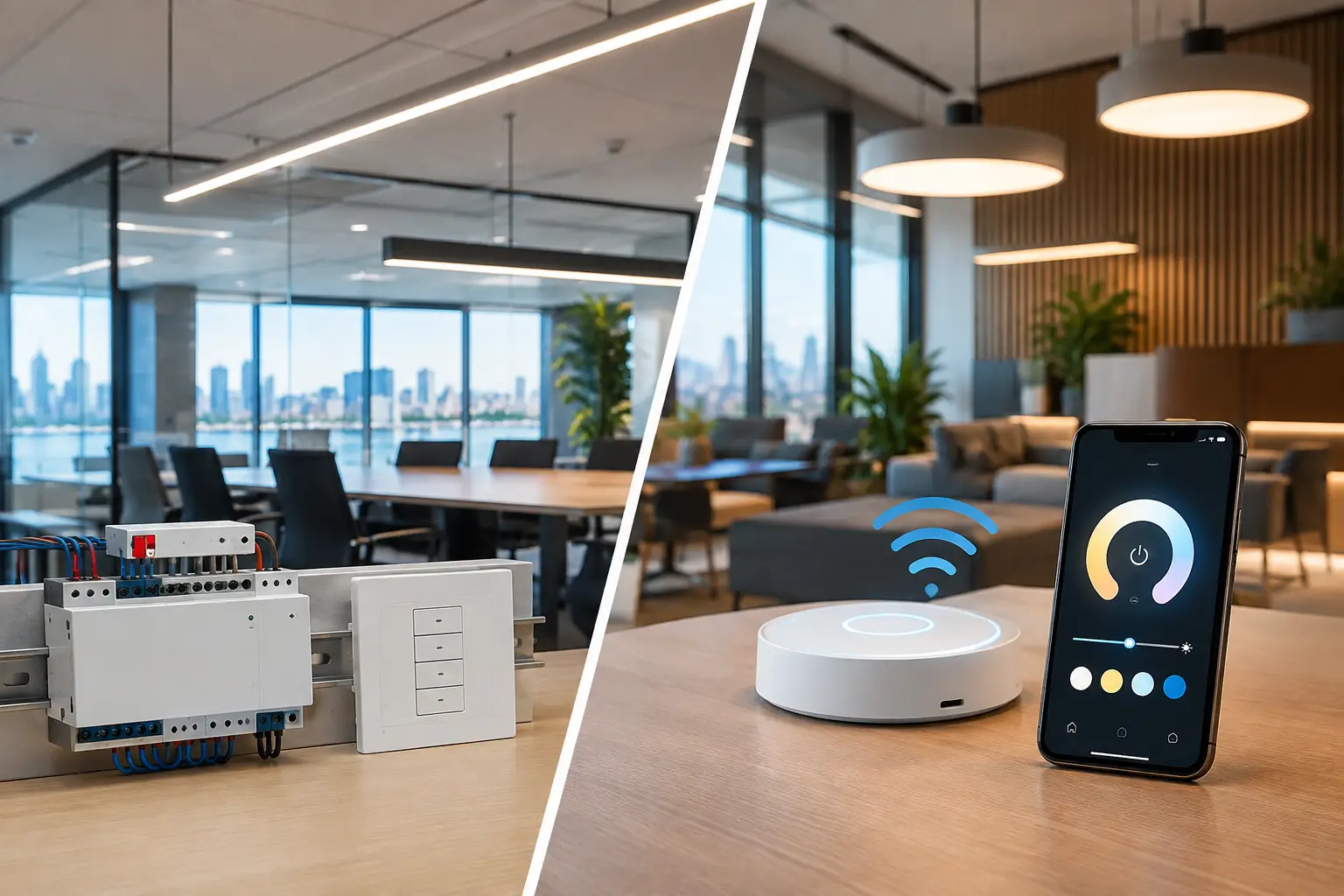
DALI-2 is a standardized wired digital lighting-control protocol. A low-voltage DALI control bus connects compatible control gear, drivers, sensors, push-button interfaces, and application controllers. Each light fitting or lighting driver can be individually addressed, grouped, programmed into scenes, and monitored from the control system.
Wireless lighting uses radio communication between controls, gateways, sensors, and light fittings or wireless modules. The underlying technology may be Zigbee, Thread, Bluetooth mesh, Wi-Fi, or a manufacturer-specific platform. Wireless systems can provide dimming, scenes, scheduling, occupancy response, and integration with broader automation platforms without requiring a dedicated lighting control cable to every device.
Both approaches can deliver excellent lighting experiences. The difference is in the infrastructure supporting them. DALI-2 prioritizes a permanent wired control layer. Wireless prioritizes installation flexibility, especially where new cabling is impractical.
Why DALI-2 is often the better foundation for new construction
In a new build or major renovation, running the right control cabling while access is available is usually the sensible decision. DALI-2 gives the project a dedicated, building-grade lighting backbone rather than relying on radio coverage and battery-powered controls in critical locations.
A DALI-2 system is particularly effective where a project has many dimmable fittings, architectural lighting zones, tunable-white fixtures, occupancy sensors, daylight harvesting, or a need for predictable scene control across multiple rooms. A well-designed system can support simple daily actions, such as an entry scene that brings hallway and kitchen lights to a useful level, while also managing more complex functions behind the scenes.
The addressable nature of DALI-2 also adds flexibility after handover. A room can be reconfigured in software without rewiring every circuit. One fitting can be reassigned to another group, scene levels can be adjusted, and sensor behavior can be refined as the space is occupied. For offices, healthcare facilities, education environments, retail spaces, and premium residences, that adaptability has real long-term value.
DALI-2 is not automatically a complete smart-home system on its own. It needs a properly selected controller or gateway to connect lighting to platforms such as Home Assistant, Apple Home, security systems, AV, or building management interfaces. This is where design matters. The lighting bus, electrical panel, network, controller, and user interfaces need to be selected as one system, not assembled as unrelated products.
Reliability comes from design, not just the protocol
Wired control has a clear advantage where reliability is non-negotiable. The DALI bus is separate from the property’s Wi-Fi network, so lighting commands do not depend on wireless signal strength or a crowded radio environment. Wall controls can remain responsive even if a mobile app, cloud service, or part of the wider network has an issue.
That does not mean every DALI-2 installation performs equally. Driver compatibility, addressing, bus loading, panel design, emergency-lighting requirements, switch input placement, and commissioning all affect the result. DALI-2 is a professional control system, and it should be treated accordingly by the electrical and automation teams.
Where wireless lighting makes practical sense
Wireless lighting is often the right answer when the building is already finished and opening walls or ceilings would be disruptive. It can bring meaningful automation to an existing home, apartment, heritage property, or occupied commercial space with less construction work.
A wireless approach may be appropriate for targeted upgrades such as adding scene control to a living area, automating lamps and selected circuits, installing occupancy control in a storeroom, or improving common-area lighting without extensive recabling. It can also be useful where the lighting design is modest and the owner values flexible changes over a dedicated wired control infrastructure.
For retrofit projects, the key is to distinguish between convenience automation and core building control. Wireless devices can work very well when they are professionally specified, positioned, and commissioned. However, a whole-property wireless lighting system needs more planning than its apparent simplicity suggests.
Wireless performance depends on the environment
Radio performance changes with construction materials, floor levels, metalwork, cabinetry, electrical interference, and the distance between devices. Concrete, stone, foil insulation, and dense commercial fit-outs can all affect signal paths. Mesh systems can improve coverage, but they depend on a sufficient number of permanently powered devices placed in sensible locations.
There are also operational questions. Will battery-powered wireless switches be acceptable in a commercial tenancy or strata common area? Who will manage firmware updates? Does the platform work locally if internet service is unavailable? Can it integrate reliably with the property’s security and automation controller? Will replacement devices remain available in five or ten years?
These are not arguments against wireless lighting. They are reasons to select the platform carefully and design it as part of the broader system. A wireless lighting installation should still have documented device locations, clear ownership of the gateway, dependable network infrastructure where required, and a support plan after installation.
Comparing the day-to-day trade-offs
DALI-2 generally requires more upfront coordination, electrical design, and installation work. The DALI bus must be planned before finishes are complete, and compatible drivers and controls must be chosen early. That upfront effort is often justified for larger projects because it creates a durable control layer that can evolve with the building.
Wireless lighting generally reduces disruption and may shorten the installation phase in an existing property. It is especially useful when the cost and inconvenience of new cable routes outweigh the benefits of a wired bus. However, it may introduce ongoing dependencies on gateways, radio coverage, batteries, platform support, and network design.
The user experience can be excellent with either option. Both can provide physical wall controls, scenes, schedules, presence-based automation, and app access. A good system does not force occupants to reach for an app to turn on a light. It gives them intuitive local control first, while automation quietly handles the repetitive tasks.
Integration should guide the decision
Lighting rarely operates in isolation. A residential system may lower lights when an alarm is armed, trigger a pathway scene when an intercom call is answered, or adjust shading and lighting together for evening comfort. A commercial property may use access control events, occupancy data, and timed schedules to manage lighting by area.
DALI-2 is well suited to this level of planned integration because individual fixtures, groups, and sensors can be exposed through an appropriate controller. Platforms such as Zen Control can provide structured DALI-2 lighting control, while Home Assistant can coordinate events across lighting, security, climate, AV, and selected wireless devices. Apple Home can provide an accessible household interface when compatible bridging and control architecture are correctly designed.
Wireless systems can also participate in these workflows, particularly in retrofit environments. The important point is to avoid creating separate islands: one app for lights, another for alarms, another for access, and another for AV. A property feels easier to operate when the underlying systems are designed to work together, even if different technologies are used behind the scenes.
Choosing the right approach for your project
DALI-2 is usually the stronger choice for new construction, substantial renovations, premium residences with detailed lighting design, and commercial projects where longevity, zoning, sensor control, and maintainability matter. It is also a sensible option when lighting needs to integrate deeply with other building systems from day one.
Wireless lighting is often the more practical choice for occupied homes, selective retrofits, small upgrades, or spaces where cabling access is limited. It can deliver significant improvement without treating the property like a construction site, provided the wireless design is based on site conditions rather than assumptions.
Some projects benefit from a hybrid design. Core architectural lighting can run on DALI-2, while carefully selected wireless controls or devices serve areas that cannot be economically recabled. The best answer is rarely ideological. It is a design decision based on the building’s future use, not simply its current floor plan.
Before selecting either path, map the lighting circuits, fixture types, control locations, network infrastructure, security events, and likely future changes. When those decisions are made together, lighting stops being a collection of switches and becomes a dependable part of how the property works.