


A meeting room that is too bright for a presentation, a hallway lit at full output overnight, and a home where every dimmer behaves differently are not minor inconveniences. They are signs that lighting has been treated as a collection of circuits rather than part of the building’s operating system. DALI lighting changes that approach by giving each fitting an address, a status, and a role within a coordinated control strategy.
For premium homes, commercial premises, education facilities, healthcare settings, and strata common areas, the value is not simply dimming lights from a wall keypad. It is the ability to design lighting that responds predictably to occupancy, time, daylight, security events, and the way a space is actually used.
What makes DALI lighting different?
DALI stands for Digital Addressable Lighting Interface. Rather than relying only on traditional switched circuits and phase-cut dimmers, a DALI system uses a dedicated digital control bus to communicate with compatible drivers, sensors, relays, and control devices.
Each DALI device can be individually addressed. That means a group of fixtures on the same electrical circuit can still be controlled separately. A designer might place pendant lights, wall washers, and downlights on one circuit for electrical efficiency, then assign them to different groups and scenes for day-to-day operation.
This distinction matters when a room needs more than on and off. A boardroom may need a bright working scene, a lower-output presentation scene, a cleaning scene, and an after-hours mode. A residence may use gentle pathway lighting overnight, task lighting in the kitchen, and a whole-home arrival scene that works alongside access control, alarms, and motorized shades.
DALI-2 is the current standardized evolution of the protocol and is particularly relevant for new installations. It improves interoperability requirements for control devices such as sensors and pushbuttons. However, a DALI-2 label is not a guarantee that every product will deliver the same experience. Proper system design, compatible components, addressing, commissioning, and documentation still determine whether the installation performs reliably.
Why addressable lighting improves daily operation
Traditional lighting often forces a compromise: either add more circuits and wall controls, or accept broad zones that do not reflect how people use the space. DALI lighting reduces that compromise because zoning happens in software as well as wiring.
In a commercial setting, this makes change less disruptive. If a tenancy is reconfigured, the lighting groups can often be updated during commissioning rather than requiring extensive rewiring. In a home, it allows the lighting design to remain refined without covering every wall in switches.
The control logic can also be more purposeful. Occupancy sensors can bring lights up only where activity is detected. Daylight sensors can reduce artificial light near windows while maintaining usable illumination deeper in the room. Timed profiles can support opening, closing, cleaning, and security routines without leaving areas unnecessarily illuminated.
There is a practical maintenance advantage as well. A well-designed DALI system can report device-level faults and driver issues through the control platform, depending on the equipment selected. Facilities teams gain more useful information than a simple report that a circuit is energized. That can shorten troubleshooting time in large offices, shared residential buildings, schools, retail spaces, and warehouses.
DALI-2 lighting works best when planned with the building
The strongest projects treat lighting controls as infrastructure, not a late-stage decorative upgrade. Fixture selection, driver location, electrical circuits, data cabling, switch locations, sensor coverage, Wi-Fi, security zones, and automation requirements should be considered together.
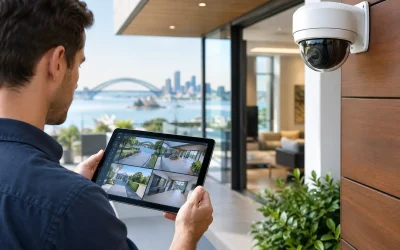
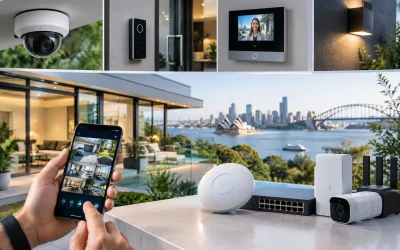
For example, an entry sequence may involve exterior pathway lighting, an intercom call, access control, CCTV coverage, and an alarm state. When these systems are designed independently, the result is often duplicated controls and inconsistent behavior. When they are planned as one connected environment, the logic can be clear: authorized access can trigger an appropriate lighting scene, while an alarm event can activate selected exterior or common-area lighting to support cameras and response procedures.
This does not mean every light should react to every event. Over-automation can quickly become frustrating. The goal is a system that behaves helpfully without creating unexpected changes in occupied spaces. A professional design process defines which events deserve an automated response, when manual control should take priority, and how the system behaves if a network service or automation controller is unavailable.
The DALI control bus itself is separate from an IP network, but the wider lighting platform may connect to an automation processor, building management system, or gateway. That integration should be intentional. Critical lighting functions should retain sensible local operation, while higher-level platforms such as Apple Home, Home Assistant, or commercial control systems add scenes, scheduling, notifications, and cross-system logic.
Where DALI lighting delivers the greatest value
DALI is especially effective where a property has multiple lighting types, changing use patterns, or a need for sophisticated scenes. It is not automatically the right answer for every small room with one simple light fitting. The added design and commissioning effort should match the operational benefit.
In high-end residences, DALI-2 supports layered lighting without visual clutter. Living areas can combine architectural downlights, feature pendants, joinery lighting, artwork illumination, and exterior lighting into scenes that are easy to recall. A wall keypad can provide immediate local control, while Apple Home or Home Assistant can extend that control to schedules and broader home routines.
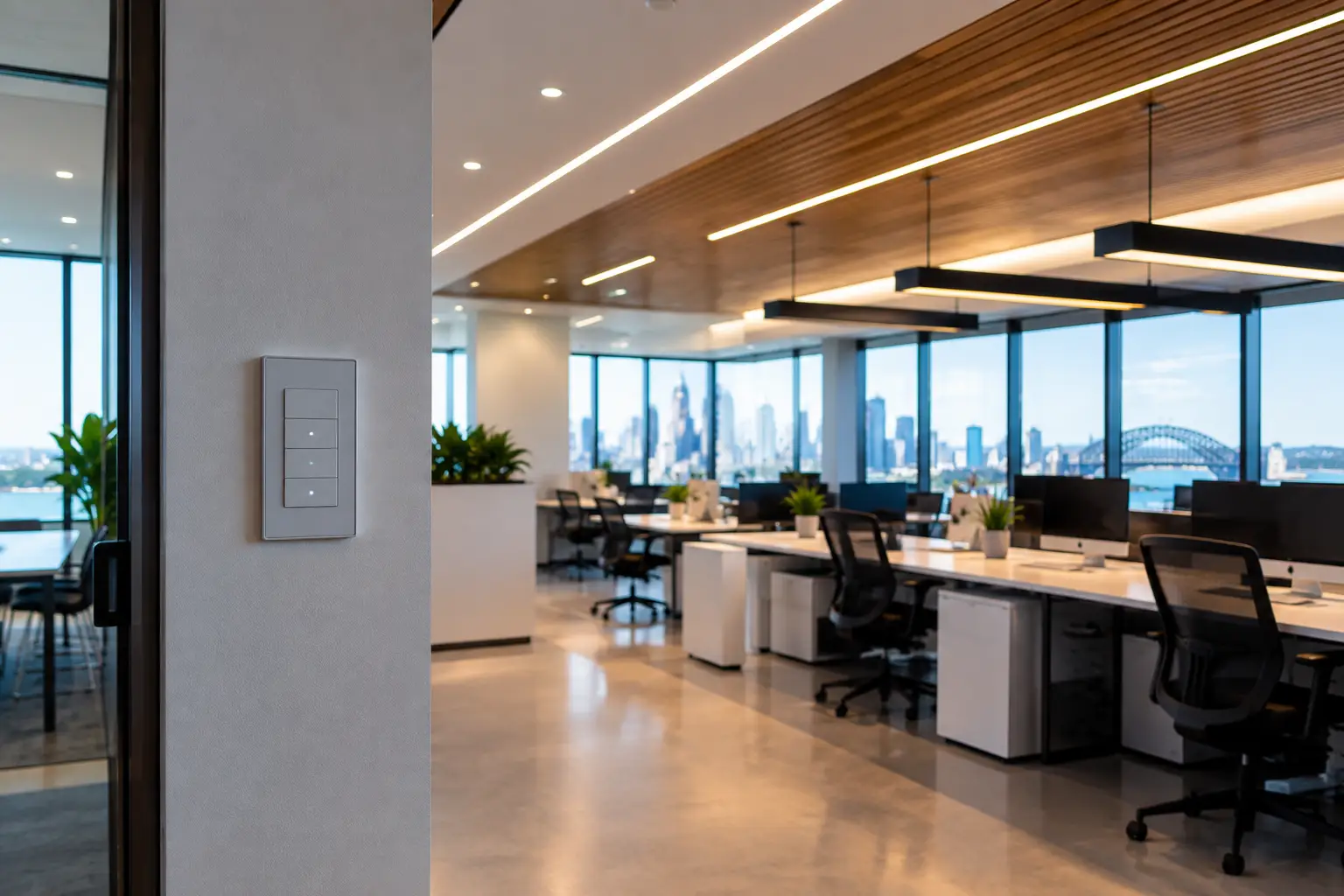
For offices and commercial sites, DALI supports practical energy management and better user comfort. Employees can work under suitable light levels, meeting rooms can change function quickly, and after-hours lighting can be limited to occupied areas. In shared spaces, a facilities manager can maintain consistent behavior across lobbies, corridors, amenities, and parking areas.
Strata properties benefit from the same principle at a larger scale. Common-area lighting must be reliable, straightforward for building managers to operate, and responsive to safety and access requirements. Carefully planned zones and maintenance visibility can make long-term operation more manageable than a patchwork of timers, relays, and disconnected sensors.
The installation details that determine reliability
DALI projects are often judged by the finish of the fixtures, but performance is decided behind the ceiling and inside the control cabinet. Driver selection, cable routing, device capacity, emergency-lighting requirements, scene programming, and commissioning records all matter.
A DALI line has device limits and electrical design rules. Those need to be calculated rather than assumed, particularly on larger sites. The control topology must also account for where drivers are accessible for future service. Concealing a driver above a difficult ceiling may look tidy on handover day but can create unnecessary cost when maintenance is required.
Commissioning deserves equal attention. Every address should be recorded, groups should follow an understandable naming convention, and controls should be tested under real operating conditions. It is worth checking what happens after a power interruption, whether local switches still work as expected, and whether sensor timeouts suit the people using the space.
Documentation is not administrative excess. A clear schedule showing fixture addresses, zones, scenes, drivers, and control devices helps future electricians, facilities managers, and automation technicians support the property without guesswork.
Integrating lighting with security and automation
Lighting is one of the most useful outputs in an integrated property system because people immediately see the result. It can reinforce security without turning normal life into a constant stream of alerts.
A practical example is an after-hours commercial site. When access control records a valid entry, the system can provide a defined route of light to the occupied area. When the final user arms the alarm, nonessential lighting can switch off after a suitable delay. If selected alarm zones activate, lighting can respond in ways that support CCTV visibility and safe investigation, subject to the site’s security plan.
At home, integration can be quieter. An intercom call after sunset may bring up entry lighting. A bedtime routine can lower common-area lights while retaining safe pathway illumination. Vacation modes can vary selected scenes, but they should never interfere with the core requirements of the alarm, cameras, or network.
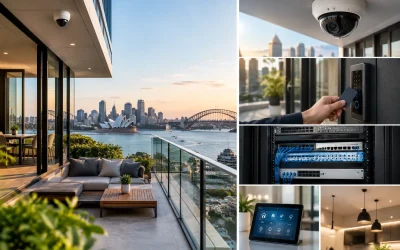
Alpha Security Corp approaches these projects as connected systems, combining licensed electrical work with security, networking, and automation design. That matters because lighting behavior is only as dependable as the infrastructure and control logic supporting it.
Start with how the property needs to operate
The best first question is not which app, keypad, or fixture looks best. It is how the property should feel and function at different times of day, during normal occupancy, after hours, and when security events occur. From there, a lighting plan can define the right mix of circuits, DALI devices, sensors, wall controls, and automation integrations.
A well-planned DALI system should fade into the background. The room is lit correctly, the controls make sense, and the property responds when it should. That is the standard worth designing for.