


A legacy alarm panel can appear to be doing its job right up until the moment it cannot send an alarm, a replacement part is no longer available, or a monitoring path fails. Knowing how to upgrade legacy alarm systems starts with treating the existing installation as infrastructure, not simply a collection of old devices. The best upgrade preserves what remains dependable, corrects hidden weaknesses, and creates a clear path for security, access, cameras, and automation to work together.
For a home, that may mean retaining quality hardwired door contacts while adding app control, verified monitoring, and practical lighting responses. For a commercial site, it may mean migrating from an aging keypad and telephone line to a managed platform with multiple communication paths, user reporting, access control, and properly planned CCTV. The goal is not to replace technology for its own sake. It is to make the property easier to secure, operate, and maintain.
Start With an Audit of the Existing System
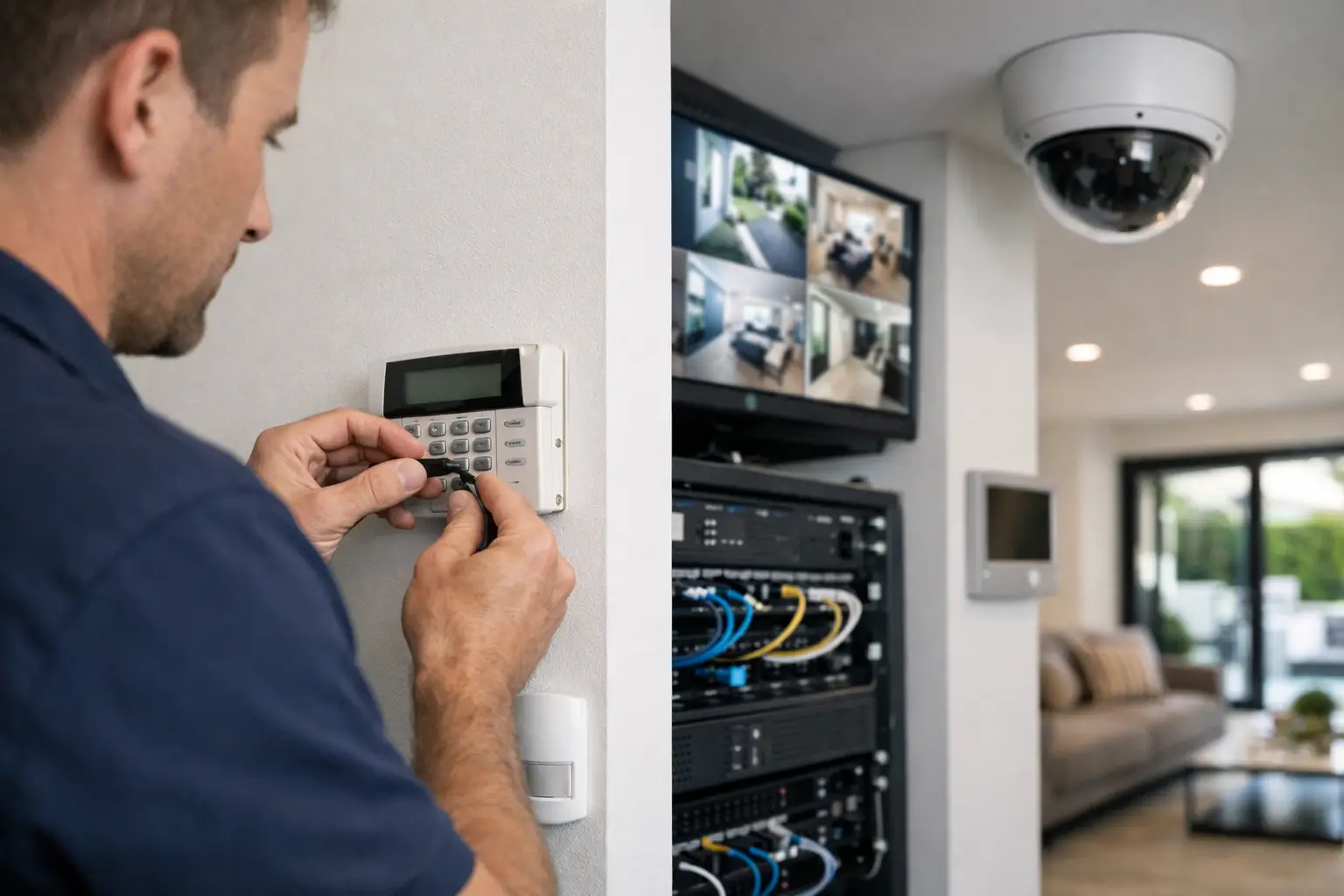
An alarm upgrade should begin at the panel, but it should not end there. A professional assessment maps the entire system: the control panel, keypads, detectors, door and window contacts, sirens, power supply, backup battery, cabling, communications equipment, and monitoring arrangement. This establishes whether the fault is limited to an obsolete communicator or whether the system has broader reliability issues.
Hardwired infrastructure often has more value than owners expect. Good-quality cabling, recessed magnetic contacts, and correctly positioned detectors can usually remain in service when they test properly. Reusing those components can reduce unnecessary disruption, especially in finished homes, strata common areas, heritage properties, and operating businesses.
At the same time, older equipment deserves careful scrutiny. A detector may still trigger during a quick walk test but have poor coverage, degraded lenses, or unsuitable placement following a renovation. Backup batteries can fail silently. A panel installed in a garage, utility closet, or riser may have inadequate power protection or limited space for a modern communications module.
A complete review should answer four practical questions:
- Which existing devices and cable runs are electrically sound and worth retaining?
- Which areas are currently unprotected, poorly covered, or difficult to arm?
- How does the system communicate an alarm, supervisory fault, or power failure?
- What other systems should interact with security, such as access control, CCTV, lighting, gates, or intercoms?
This audit prevents a common mistake: fitting a new communicator to an old panel without addressing the system around it.
Replace Obsolete Alarm Communications First
Many legacy systems were designed around landlines, older cellular services, or communications formats that are no longer dependable. When that path disappears, the alarm may still sound locally but fail to notify the monitoring center or property owner. That is not a minor inconvenience. It changes the system from supervised security to a local noise-making device.
Modern alarm communication should be selected for the property’s risk profile. Cellular monitoring is often appropriate where a reliable signal is available, while IP reporting can provide fast communication through a properly managed network. Higher-risk sites may benefit from dual-path reporting, where cellular and IP paths supervise each other. The right design depends on the site, the insurer’s requirements, the monitoring service, and the consequences of an outage.
A network connection should never be treated as an afterthought. If an alarm panel relies on the property network, the network needs suitable coverage, stable switching, backup power where required, and sensible separation from guest or consumer devices. A well-designed UniFi network, structured cabling, and appropriate power backup can make connected security systems more dependable than a patchwork of standalone wireless products.
Choose a Panel That Supports the Next Stage
The replacement panel is the decision that shapes every later improvement. A good modern panel should support the required number of zones, communications paths, user permissions, partitions, event reporting, and integration options without forcing the property into a closed, short-lived ecosystem.
For many existing properties, a hybrid panel is a sensible choice. It can retain tested wired zones while accepting wireless devices where new cabling would be intrusive. This is useful for extensions, detached garages, renovated rooms, and doors added after the original system was installed. Wireless devices are not inherently inferior, but they need the same disciplined planning as wired devices: signal testing, battery maintenance, tamper supervision, and correct device selection for the environment.
The choice between Bosch and another professional platform, for example, should be based on the site’s needs rather than a feature checklist alone. A small residence with a few protected entry points has different requirements from a multi-tenant commercial building with separate areas, staff schedules, monitored access doors, and detailed reporting. The panel should fit the operational model, not merely the building size.
Redesign Coverage Instead of Copying Old Zones
When considering how to upgrade legacy alarm systems, it is tempting to duplicate every old zone on the new panel. That preserves the original shortcomings. A better approach reassesses how people enter, move through, and use the property now.
A renovation may have changed sight lines and movement patterns. An old motion detector may now face a large window, a heat source, or an open-plan living area. A business may have introduced a stockroom, server cabinet, controlled drugs storage, or new loading access that was not present when the alarm was first installed. These changes should influence detector type, zone logic, entry and exit timing, and arming procedures.
Security works best when daily use is simple. If staff or family members regularly bypass zones because the system is inconvenient, the design has failed. Separate partitions can help a business arm an office while a warehouse remains active. Perimeter arming can let homeowners protect doors and windows at night while moving freely indoors. Properly configured notifications can distinguish between an alarm event, a door left open, a low battery, and a communications fault.
Connect Alarms to Access, CCTV, and Lighting With Purpose
An upgraded alarm system becomes more useful when it shares meaningful events with other property systems. Integration should solve an operational problem, not create a screen full of novelty controls.
For commercial properties, an access control event can identify who opened a protected door, while nearby Dahua or Hikvision CCTV can provide associated video evidence. An alarm condition may trigger specific camera recording behavior, activate lighting in a defined area, or notify designated managers with the right level of detail. Intercom systems such as Akuvox can also support a more controlled entry workflow when access points, gates, and visitor management are part of the site’s security plan.
At home, practical integration might mean exterior lighting responding when the system is disarmed after dark, selected lights turning on during an alarm event, or an Apple Home or Home Assistant interface showing useful security status alongside lighting and climate controls. These automations need careful limits. Alarm arming, disarming, and life-safety-related behavior should remain secure, intentional, and aligned with the capabilities of the security platform.
Integration depends on reliable underlying infrastructure. A premium interface cannot compensate for weak Wi-Fi, overloaded consumer networking equipment, poor cable pathways, or inconsistent electrical supply. Planning alarms alongside structured cabling, network hardware, electrical work, and smart lighting creates a more dependable result than adding integrations one device at a time.
Plan the Installation Around Continuity and Testing
An alarm replacement affects the property’s security posture during the changeover. For occupied homes and active businesses, installation should be planned to minimize unprotected periods. That may involve preconfiguring the new panel, testing reusable zones before migration, scheduling the cutover outside trading hours, and coordinating monitoring changes in advance.
After installation, every zone should be tested under normal operating conditions. That includes door contacts, motion detectors, panic devices where fitted, tamper circuits, sirens, backup battery operation, mains-failure reporting, and each communication path. Monitoring should be confirmed with actual test events, not assumed because an app shows the panel as online.
Documentation matters as much as testing. The property owner or manager should receive clear information on zones, user access, communications, maintenance responsibilities, and service contacts. Commercial sites should also establish who can add or remove users, review event reports, and authorize changes. Without ownership of those processes, even sophisticated systems gradually become difficult to manage.
Build in Maintenance From Day One
Modern systems provide more visibility, but they still require maintenance. Batteries age, detectors become contaminated, building layouts change, and network or carrier services evolve. A regular service program identifies these issues before they become a failure at the wrong time.
Maintenance is also the opportunity to refine the system. A recurring false alarm, an entry door that is frequently propped open, or a camera that lacks useful nighttime detail is operational feedback. The answer may be a configuration adjustment, a different detector, better lighting, an access control change, or a revised procedure. Treating security as a managed property system keeps it aligned with how the building is actually used.
The most successful upgrades respect the value already inside the walls while preparing the property for what comes next. A well-designed alarm is not an isolated panel with a new keypad. It is a dependable part of a connected environment that gives owners, occupants, and managers clearer control when it matters most.