


The right entry system usually becomes obvious the day it fails a real-world test. A courier arrives while nobody is home, a resident wants to screen visitors from multiple indoor stations, or a business needs to control front-door access without relying on someone’s phone battery. That is where the intercom vs smart doorbell question stops being about features and starts being about how the property actually operates.
For some buildings, a smart doorbell is enough. For others, it is the wrong tool entirely. The difference comes down to how much control, reliability, and integration the site needs, both now and as the system grows.
Intercom vs smart doorbell: the core difference
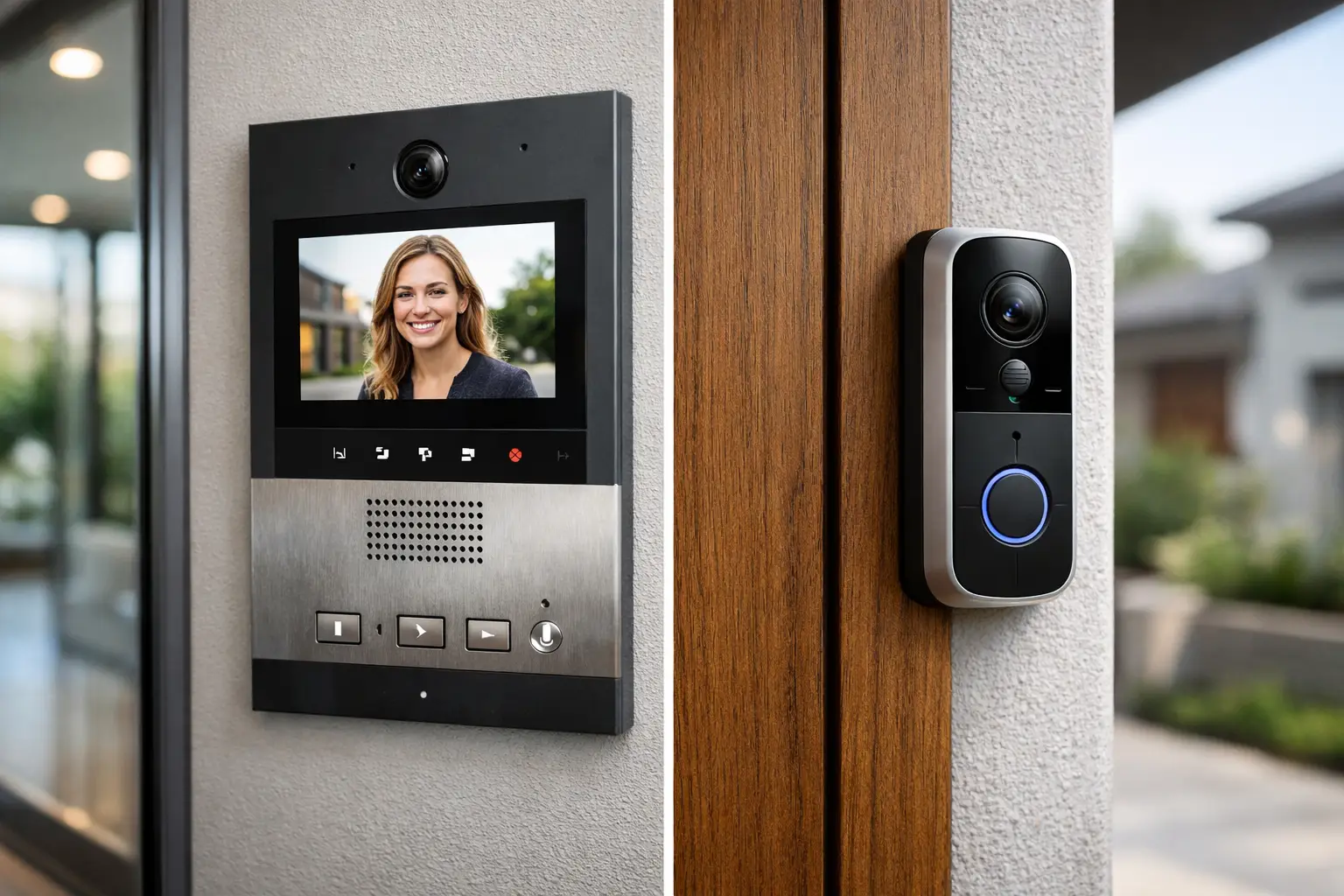
A smart doorbell is usually a single front-door device with a camera, button, app notifications, and two-way talk. It is designed around convenience for one entrance and typically relies heavily on mobile access. For a standalone home with straightforward needs, that can work well.
An intercom system is broader. It is built for communication and managed access across one or more entry points, often with indoor monitors, door release, multiple users, and better support for gates, lobbies, apartments, offices, and mixed-use properties. Platforms such as Akuvox are designed with this wider role in mind, especially when visitor communication needs to tie into access control, network infrastructure, and building-wide management.
That does not make one universally better than the other. It means they solve different problems.
When a smart doorbell makes sense
A smart doorbell is often the natural fit for a single-family home that wants basic front-door visibility. If the main goal is seeing who is at the door, speaking through an app, and reviewing motion events, a well-placed doorbell camera may cover the requirement without adding indoor stations or a more structured access setup.
This option also suits retrofits where the owner wants minimal disruption and the site has one obvious visitor entry. If the rest of the home is already centered around Apple Home or Home Assistant, a compatible smart doorbell can become one piece of a broader automation setup. A doorbell press might trigger porch lighting, a camera pop-up, or selected notifications during certain hours.
The trade-off is that smart doorbells are often strongest as standalone devices, not as part of a serious entry management system. They are convenient, but convenience is not the same as operational depth.
Where intercoms pull ahead
Intercoms become the better choice when the property needs more than video chat at the front door. That includes homes with gates and pedestrian entries, multi-story residences where indoor answering matters, strata buildings with shared access points, and commercial sites where staff need to verify visitors and unlock doors in a controlled way.
A proper intercom system can support indoor monitors, mobile answering, PIN or credential access, integration with electric strikes or gate motors, and clear separation between users and entry zones. It also creates a more dependable user experience for households or teams that do not want every access event to depend on one person’s phone.
For example, a large residence may want a front gate station, a main entry station, indoor monitors on each level, and integration with CCTV and lighting scenes. A strata site may need tenant directories, door release, auditability, and expansion over time. An office may want a visitor to call reception, trigger a lock release, and record camera footage on the same network. These are intercom jobs, not just doorbell jobs.
Security is not just about seeing the visitor
Many smart doorbell conversations focus on video quality, motion alerts, and package detection. Those are useful, but they are only part of entry security. The larger question is what happens after identification.
If you need to grant access to a gate, front door, lobby, or internal tenancy door, an intercom provides a much more structured path. It can be tied to access control rules, credential management, and monitored entry points. It also tends to fit better with professionally designed CCTV systems from platforms like Dahua or Hikvision, where recording, camera coverage, and event handling are planned together rather than added one device at a time.
That matters in homes as much as commercial sites. Seeing a person at the door is useful. Being able to verify them, communicate clearly, unlock the right entry point, and keep that event within a reliable system is better.
Reliability depends on infrastructure
This is where many comparisons get too simplistic. A consumer doorbell may look similar to an intercom at a glance, but infrastructure changes the result.
Smart doorbells often depend on Wi-Fi quality, cloud services, app responsiveness, and battery maintenance if they are not hardwired properly. In a home with weak wireless coverage at the front boundary, delayed notifications and dropped video are common failure points. In larger properties, detached gates, or commercial environments, those weaknesses become more obvious.
Intercoms are usually planned with cabling, stable power, fixed network connectivity, and defined hardware locations. When paired with structured cabling and solid network design, often using UniFi infrastructure in residential and commercial projects, they tend to behave more like part of the building than an accessory attached to it.
That is a major reason professionally installed systems hold up better over time. Good entry technology starts with good electrical and network planning.
Integration changes the value of both options
The strongest systems are not isolated. They are designed to work as one.
A smart doorbell can absolutely play a role inside a connected property, especially if the objective is lightweight front-door awareness. But integration is usually narrower. You may get notifications, a smart display popup, or a simple automation trigger.
An intercom can sit much deeper in the system architecture. It can connect with gate control, internal monitors, CCTV views, access control events, network permissions, and smart-home routines. In the right design, a visitor call can trigger lighting scenes, show the relevant camera on an indoor touch panel, log an access event, and allow controlled release of a specific door or gate. In a commercial setting, that same logic can support reception workflows, delivery access, or after-hours visitor handling.
This is especially relevant for new builds and major renovations. If the property already includes smart lighting, surveillance, networking, and automation, the entry system should be chosen as part of that plan, not after it.
Intercom vs smart doorbell for different property types
For a smaller single-entry home, the answer may be straightforward. If the owner wants visibility and app-based communication without managing multiple doors or users, a smart doorbell may be enough.
For larger homes, intercoms usually make more sense once there is a gate, a secondary entrance, or a need for indoor stations. The same applies when family members, house staff, or guests need reliable answering points beyond one mobile app.
For strata, a dedicated intercom is the practical choice in almost every case. Shared entrances, multiple occupants, controlled release, tenant changes, and serviceability all point toward a proper intercom platform.
For offices, warehouses, healthcare sites, and schools, the decision is even clearer. Visitor management, staff workflow, compliance expectations, and controlled access demand a system with more structure than a residential-style smart doorbell can usually provide.
What to ask before choosing
The better question is not which device is more popular. It is what the site needs the entry point to do.
If you are comparing options, look at the number of entrances, whether door or gate release is required, whether indoor answering matters, how many users need access, what network infrastructure is available, and how the entry system should interact with CCTV, alarms, lighting, and automation.
Also think beyond day one. Many owners choose a simple doorbell because it feels faster, then later add gates, cameras, Wi-Fi upgrades, access control, or Home Assistant logic and realize the original choice does not scale cleanly. A system that is slightly more considered upfront often avoids a fragmented upgrade path later.
Alpha Security Corp approaches this by designing entry systems as part of the wider security and automation environment, so the result is usable every day and supportable long term.
The better choice is the one that matches the building
Intercom vs smart doorbell is not really a gadget comparison. It is a building-use decision. A smart doorbell is often suitable for simple residential front-door awareness. An intercom is the better fit when the property needs managed access, multiple entry points, indoor stations, or stronger integration with the rest of the system.
If the property is expected to do more than show a video feed and send a phone alert, it is worth planning the entry system like infrastructure, not an add-on. That usually leads to a cleaner, more reliable result that still makes sense years after installation.