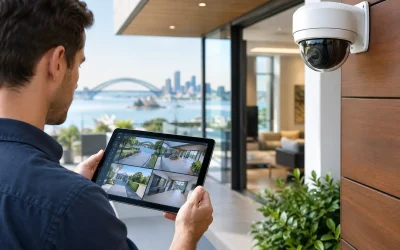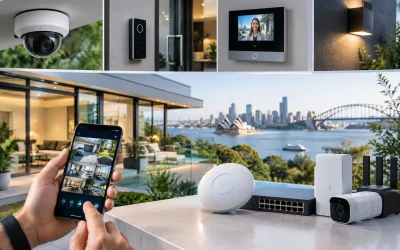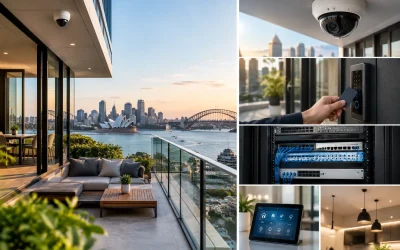



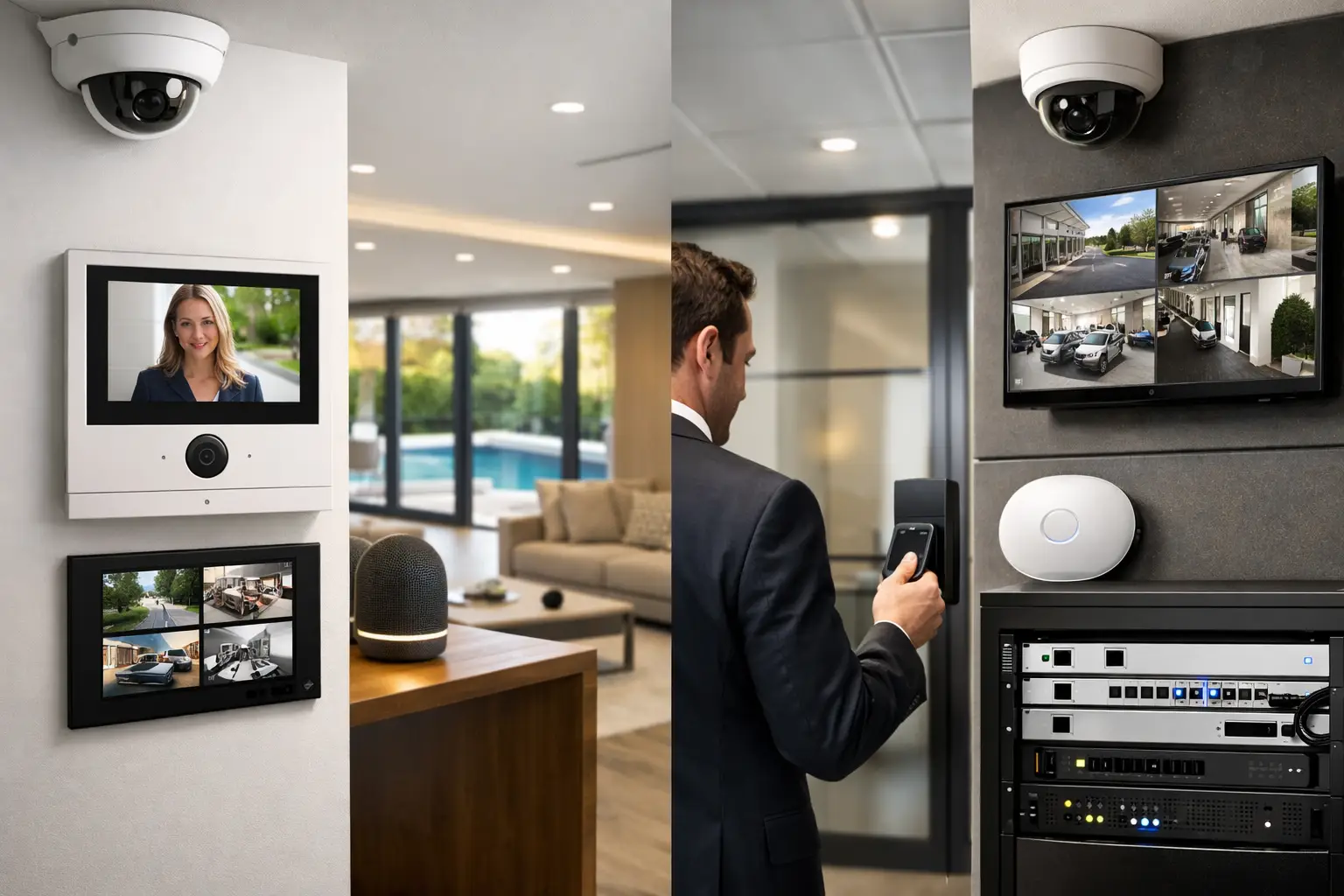
An alarm panel, cameras, Wi-Fi, door access, lighting controls, and intercom can all be excellent products on their own. But when they are planned and installed independently, the property owner is often left managing separate apps, separate contractors, and separate points of failure. Security integration changes that outcome by designing these systems to operate as one practical environment.
For a homeowner, that may mean an intercom call is answered from a phone, the gate is released after visual verification, exterior lighting responds appropriately, and camera footage is available from the same trusted interface. For a commercial site, it can mean access events, alarm activity, video verification, network health, and after-hours lighting are organized around how the building actually operates.
The value is not having more technology. It is having technology that is easier to use, easier to support, and properly prepared for the next stage of the property.
Security Integration Starts With Infrastructure
The most visible devices are rarely the foundation of the system. Reliable integration begins behind walls, in communications cabinets, at electrical switchboards, and across the network. A camera with poor network design, an access controller without adequate backup power, or a smart lighting system added after construction without the right cabling can create avoidable limitations.
This is why new builds and major renovations benefit from coordination early in the design process. Structured cabling should account for camera locations, wireless access points, intercoms, televisions, control keypads, access-controlled doors, and future equipment. Electrical planning should account for the circuits, switching, backup requirements, and control hardware the property will need.
A well-designed UniFi network, for example, gives security devices a dependable communications layer while also supporting workstations, streaming, guest access, and smart-home platforms. Network segmentation can keep CCTV, access control, and automation devices appropriately separated from everyday user traffic. This improves manageability and reduces the risk that a consumer device or guest connection affects a critical service.
For existing properties, the approach is more selective. Not every retrofit requires opening every wall or replacing every system. The right path depends on the available cabling, construction type, current equipment, and the outcome the owner wants. A site assessment identifies where existing infrastructure can be retained and where targeted upgrades will provide the greatest long-term benefit.
What a Connected Security System Can Do
A connected system should make real decisions and daily actions simpler. It should not create a complicated chain of rules that only the installer understands.
Consider a residence with perimeter cameras, an alarm, Akuvox intercom, DALI-2 lighting, Apple Home, and Home Assistant. A visitor at the gate can trigger a notification with live video. Once verified, the occupant can release the gate or door, while selected entrance lighting activates after dark. If the alarm is armed, the system can distinguish between an authorized arrival and an unexpected event based on the chosen logic and permissions.
The same thinking applies to commercial premises. Access control credentials can define who can enter particular areas and when. CCTV can provide visual context around a door event or alarm condition. An intercom can route calls to the appropriate team member. After-hours schedules can reduce unnecessary lighting and allow the site to move into a defined secure mode without relying on staff to remember a long closing checklist.
The integration does not need to be identical at every site. A warehouse may prioritize loading dock coverage, gate access, network resilience, and monitored alarm response. A medical practice may need carefully controlled access to staff-only areas, clear visitor management, and dependable coverage of reception and entry points. A high-end home may place greater value on discreet control, dependable Wi-Fi, privacy-conscious camera positioning, and lighting scenes that feel natural rather than theatrical.
Design Around Events, Not Devices
The most useful design question is not, “Which camera should we buy?” It is, “What should happen when this event occurs?” That question brings the full property into view.
When an alarm activates, for example, the system may need to notify the right people, provide relevant camera views, activate exterior lighting, and communicate with a monitoring service. When a staff member presents a credential at a restricted door, the priority may be recording the event, granting or denying access, and retaining a clear audit trail. When a resident arrives home, the preferred experience might be a secure gate release, pathway lighting, and a change from away mode to occupied mode.
This event-based approach exposes trade-offs early. More automation is not always better. A lighting response that is useful after a verified perimeter event could be disruptive if it occurs every time a camera detects movement. AI-enabled CCTV can improve the relevance of alerts by distinguishing people, vehicles, and other events, but detection settings still need to suit the site. A busy street, nearby trees, pets, and delivery activity all affect how rules should be configured.
Good integration is deliberate. It uses automation where it removes friction or improves response, while retaining clear manual controls for the moments when people need certainty.
Security Integration Requires the Right Platform Choices
There is no single platform that is best for every property. Bosch, Dahua, Hikvision, Akuvox, UniFi, Apple Home, Home Assistant, DALI-2, Zen Control, and access control platforms each have strengths within the right design.
A commercial security system may favor purpose-built controllers, centrally managed cameras, defined user roles, audit reporting, and monitoring compatibility. A sophisticated residence may combine an Apple Home interface for everyday family use with Home Assistant for more advanced cross-platform logic. DALI-2 lighting can provide detailed control and scalable scene management where the electrical and lighting design supports it.
The platform decision should also consider ownership and support. Who will add or remove staff access? Who receives critical alerts? What happens if the internet connection is unavailable? How will credentials, passwords, firmware, and recorded footage be managed? Can the system expand without replacing the foundation?
These questions are particularly relevant for strata properties and businesses with changing occupants or teams. A system that works beautifully on handover day but has no clear administration process can become unreliable within a year. Proper documentation, labeled equipment, defined user permissions, and a maintainable network are part of the installation, not an optional extra.
A Practical Delivery Process
Integrated projects work best when security, electrical, networking, and automation are coordinated rather than sequenced as unrelated trades. Alpha Security Corp approaches this as a design-install-service process, with each stage informed by the operational needs of the property.
A sound process usually includes four connected steps:
- Site and requirement review, including property layout, risk areas, user needs, construction constraints, and future expansion plans.
- System design, covering device locations, cable pathways, cabinet space, power, network architecture, platform compatibility, and control methods.
- Installation and commissioning, where devices are installed, settings are tuned to the environment, and each integrated response is tested under realistic conditions.
- Handover and ongoing support, including user training, documentation, maintenance planning, monitoring arrangements where required, and a clear path for later upgrades.
Commissioning deserves particular attention. A camera system should be tested in the lighting conditions it will face, not only during installation. Access control should be tested for normal entry, denied entry, emergency egress, and loss-of-power scenarios. Automation should be tested by the people who will use it, because an elegant rule on paper may not suit how a family, receptionist, building manager, or facilities team works day to day.
Plan for Reliability and Change
Every connected property changes. A family adds a vehicle, a business hires staff, a tenant changes, a renovation adds rooms, or a security concern shifts to another part of the site. The strongest systems do not assume the property will remain static.
That does not mean installing every possible device from the beginning. It means allowing room in the rack, choosing a network that can scale, retaining cable records, providing sensible power capacity, and selecting platforms that can grow with the building. It also means avoiding designs that depend on one obscure device or a single undocumented workaround.
For properties across Sydney and NSW project sites, this level of planning is especially valuable when different contractors, construction schedules, and stakeholder groups are involved. One coordinated technical plan reduces rework and helps ensure the finished property performs as intended.
A properly integrated system should feel quiet in operation. Doors work when they should. Wi-Fi reaches the spaces that matter. Lighting responds with purpose. Security events provide useful information rather than constant noise. That is the standard worth designing for: a property that remains secure, usable, and ready for what comes next.