


A well-designed lighting system should not make you reach for an app every time you enter a room. It should respond naturally to how the property is used: lighting a safe path from the driveway, setting the right level for a meeting, securing a vacant commercial space after hours, or making a home feel settled at night. Smart lighting is most valuable when it becomes part of the property’s electrical, security, and network design rather than a collection of isolated controls.
For new builds, major renovations, and commercial fit-outs, lighting is one of the best opportunities to plan connected technology correctly from the beginning. For existing properties, the same outcome can often be achieved through a considered retrofit, provided the electrical infrastructure, wireless coverage, and control requirements are assessed first.
Smart Lighting Is a System, Not a Set of Bulbs
Many people first encounter smart lighting through a connected lamp or wireless switch. Those products can be useful in a small area, but they are not the same as a property-wide lighting system. A professionally planned system considers the fixtures, dimming method, switch locations, control modules, scenes, sensors, network, electrical circuits, and the platforms that will coordinate them.
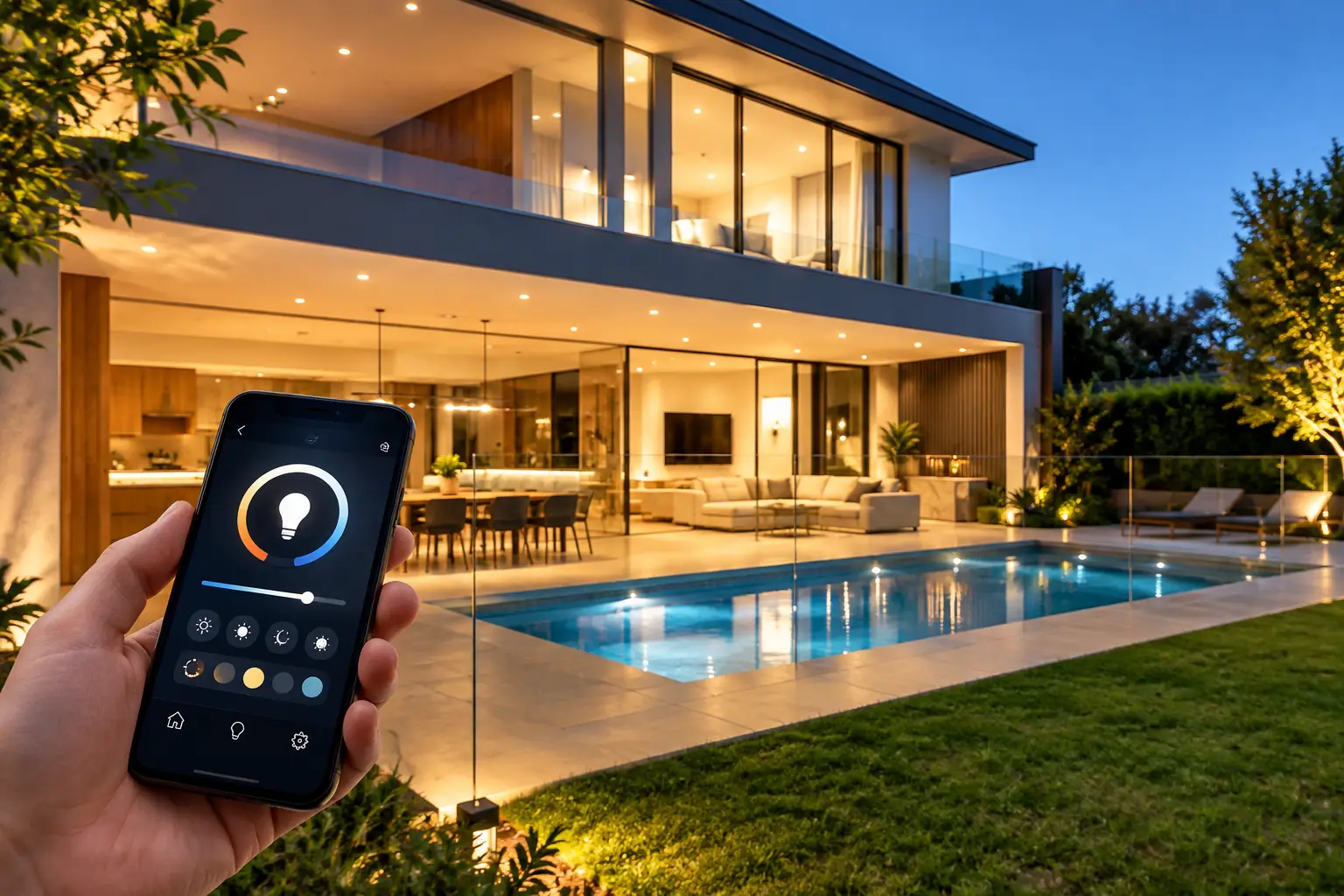
That distinction matters because lighting is used constantly. If a control is slow, unreliable, poorly labeled, or dependent on a phone application, people will bypass it. The best systems retain familiar wall-switch operation while adding useful intelligence in the background. A guest should be able to use a room without instruction. The owner should be able to adjust the property from a wall keypad, touchscreen, voice assistant, Apple Home, Home Assistant dashboard, or approved remote interface when needed.
The objective is not to automate every light. It is to make the right actions simple and repeatable.
Start With How Each Space Is Actually Used
A lighting plan should begin with behavior, not equipment. In a residence, that means considering arrival, entertaining, cooking, bedtime, overnight movement, cleaning, and time away. In an office, retail site, warehouse, healthcare setting, or strata common area, it means understanding operating hours, task lighting, cleaning access, presentation needs, occupancy, emergency requirements, and after-hours security.
A kitchen, for example, may need bright, even task lighting during food preparation, softer lighting during meals, and low-level pathway lighting late at night. A boardroom needs a different approach: a presentation scene that balances screen visibility with face-to-face discussion, followed by an all-off routine that does not accidentally leave decorative or perimeter lighting operating overnight.
Scene-based control puts these combinations behind a single action. “Arrive Home” might illuminate the entry, kitchen, and selected exterior areas. “Goodnight” can turn off general lighting, leave a safe hallway level, lower blinds where integrated, and arm the appropriate security mode. In commercial spaces, an “Open” scene and a secure “Close” scene can reduce reliance on staff remembering a sequence of switches.
Good scene design is restrained. Too many choices create confusion. A practical system uses clear scenes that reflect real routines and allows manual control wherever it is expected.
Choosing the Right Control Architecture
The correct technology depends on the size of the project, the available wiring, the desired level of integration, and future expansion plans. There is no single platform that suits every property.
For larger homes, premium renovations, and commercial environments, wired lighting control can provide a dependable foundation. DALI-2 is a widely used digital lighting control standard that allows individual fixtures or groups to be addressed, dimmed, monitored, and reconfigured with greater flexibility than conventional switched circuits. It is particularly well suited to projects with many fittings, changing room layouts, detailed zoning, or energy-management requirements.
Systems such as DALI-2 with Zen Control can deliver refined architectural lighting control while maintaining an intuitive user experience. The value is not simply that lights can dim. It is that groups, scenes, schedules, occupancy responses, and daylight behavior can be managed deliberately across the building.
Wireless controls can be an excellent option for retrofit work where opening walls or adding control cabling is not practical. However, wireless design still requires discipline. Device placement, electrical compatibility, radio coverage, local control behavior, and long-term support must be considered. A wireless device should not be installed merely because it is convenient on the day. It needs to operate reliably in the finished property alongside Wi-Fi, security equipment, and other connected systems.
In many projects, the strongest result is a hybrid approach: wired infrastructure where it provides resilience and scale, with carefully selected wireless controls where they solve a genuine retrofit or flexibility requirement.
Lighting, Security, and Automation Should Share Context
Lighting becomes more useful when it can respond to events elsewhere in the property. This is where integrated design makes a measurable difference.
When an access control reader grants entry to a staff door after hours, the appropriate corridor and work-area lighting can activate for a defined period. When an intercom call is answered at a residence, the entry lights can come on before the door is opened. When an alarm is triggered, selected lights can turn on to support cameras, deter intrusion, and help occupants move safely. These responses should be planned carefully so they support security without creating false alerts or unnecessary disturbance.
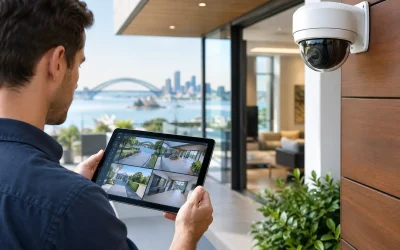
AI-enabled CCTV can also provide useful context. A person detected near a gate at night may trigger a controlled lighting response, while routine vehicle or environmental movement does not. The settings need to be tuned to the site, camera field of view, and operating hours. More automation is not always better. At a commercial site, activating all exterior lights for every detection event may be wasteful and distracting. A targeted response is usually more effective.
At home, Apple Home and Home Assistant can bring lighting together with security status, doors, temperature, audio visual systems, and occupancy logic. Apple Home is often valued for its familiar interface and straightforward household control. Home Assistant can suit projects requiring more detailed logic, cross-platform integration, and custom dashboards. Either platform benefits from dependable underlying electrical and network design.
The Network Is Part of the Lighting Design
Connected lighting is often treated as an electrical-only scope, but a reliable network is just as relevant. Control processors, gateways, mobile applications, wireless switches, voice services, cameras, and automation platforms all depend on connectivity. Weak Wi-Fi or an overloaded consumer network can make an otherwise well-designed system feel inconsistent.
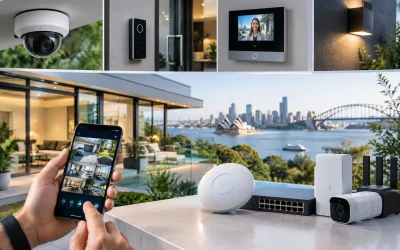
A structured cabling and UniFi network plan provides a better foundation for connected properties. Wired connections can be used for fixed control equipment where appropriate, while correctly located access points support mobile control and wireless devices. Network segmentation can also help separate building systems from general user devices, improving management and reducing unnecessary exposure.
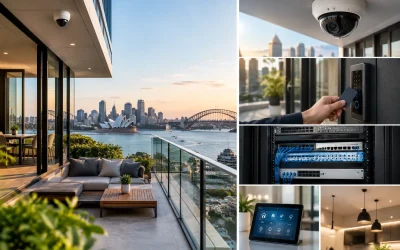
This planning is especially important in larger homes and commercial sites. A lighting scene may be simple, but the environment supporting it often includes access control, CCTV, intercoms, multiroom audio, remote support, and multiple users. Designing these systems as one technical environment avoids duplicated equipment and conflicting assumptions between trades.
Plan for Serviceability and Change
The property will change after handover. Tenants move, staff roles change, furniture is rearranged, rooms are repurposed, and family routines evolve. A lighting system should be able to adapt without requiring a major rewire for every adjustment.
That means documenting circuits, fixture groups, panel locations, scenes, device addresses, and control logic. It also means allowing sensible capacity in switchboards, control panels, cable pathways, and network infrastructure. In commercial projects, managers should know who can alter schedules and who can request more significant changes. In residential projects, owners should receive clear, practical guidance rather than being left with an unexplained collection of apps.
Maintenance also matters. LED fittings, drivers, sensors, dimming modules, and software platforms all have service considerations. Selecting compatible components and maintaining accurate records makes fault finding faster and reduces disruption later. Alpha Security Corp approaches lighting alongside electrical, security, and automation infrastructure so responsibility does not fall between separate installers when a system needs attention.
Smart Lighting Should Feel Considered, Not Complicated
The most successful lighting systems are rarely the ones with the most visible technology. They are the ones that provide the right light, at the right time, with controls that remain understandable years after installation.
Before selecting fixtures or platforms, map the daily routines, critical security events, operating schedules, and future needs of the property. That early design conversation turns smart lighting from a feature list into a dependable part of how the building works.