



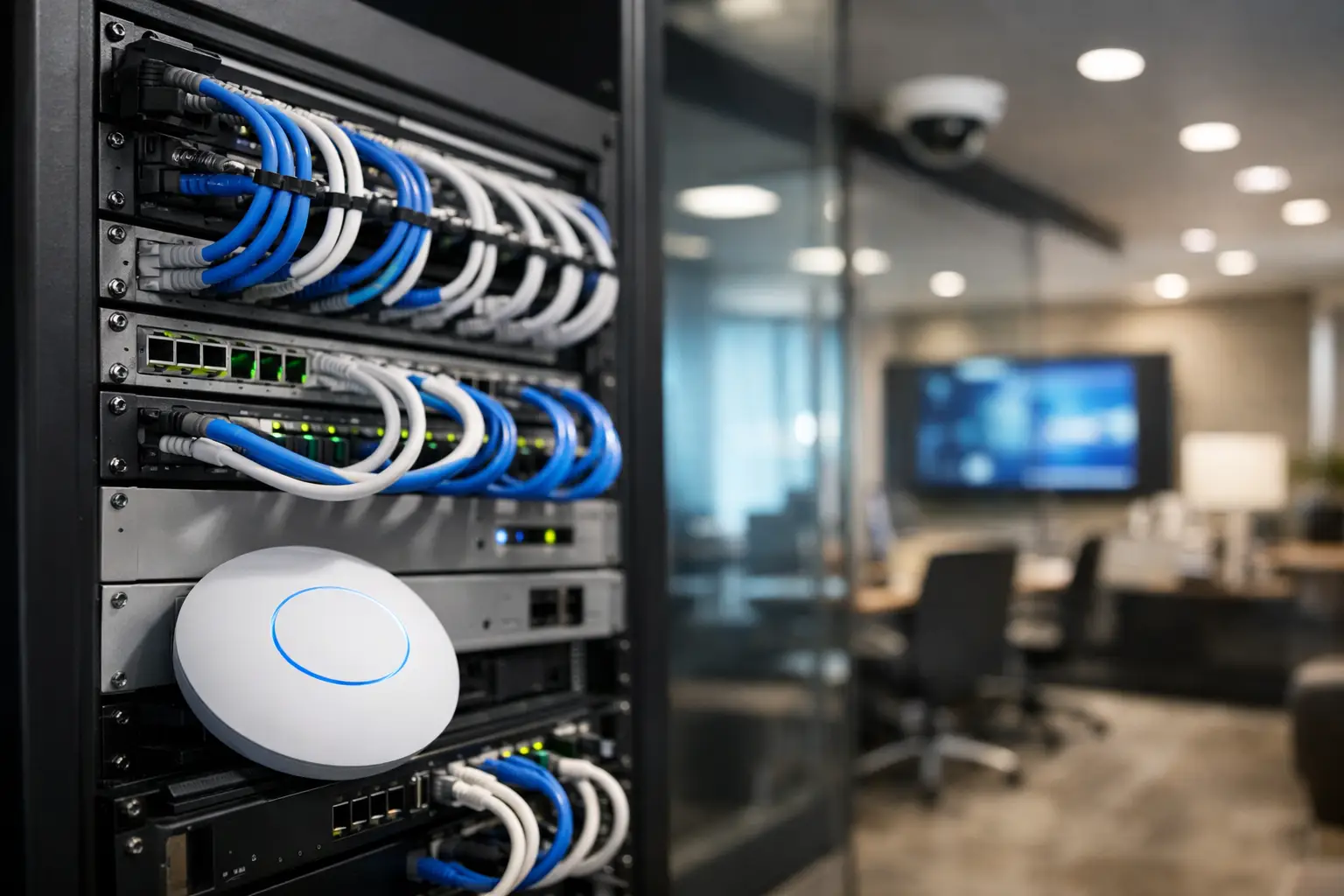
A camera that drops out when it matters, Wi-Fi that slows down during a video call, or an intercom that cannot support a new access-control workflow often points to the same underlying issue: the property’s cabling was never designed for its current demands. Upgrading structured cabling is not simply about replacing old network outlets. It is an opportunity to create the physical foundation for security, networking, automation, AV, and building systems that need to work together reliably.
For homeowners, builders, strata managers, and commercial decision-makers, the right upgrade begins with a clear view of what the property needs to support now and what it may need to support in five or ten years. The cable in the walls is difficult to revisit after finishes are complete. Planning it properly can prevent a series of expensive, isolated technology fixes later.
Why Structured Cabling Becomes a Limitation
Structured cabling is the organized network of copper and fiber cabling, outlets, pathways, patch panels, and equipment locations that connects a property’s technology. When it is well planned, a switch, wireless access point, camera, access-control reader, television, or automation controller has a documented and dependable connection point. When it is not, the result is often a patchwork of extension leads, unmanaged switches, wireless bridges, and cables installed only where a problem appeared.
Older cabling may still function for basic internet access, yet fall short when multiple high-bandwidth or power-hungry devices are added. This is particularly common where an existing home is being renovated into a connected property, or where a business expands CCTV coverage and access control without revisiting the network cabinet.
Common warning signs include unreliable cameras, inconsistent Wi-Fi between areas, limited outlet locations, slow file transfers, congested communications cabinets, unlabeled cables, and no spare pathways for future work. None of these automatically means every cable must be replaced. A professional assessment can identify whether the issue is cable category, poor termination, inadequate switching, lack of power over Ethernet, pathway constraints, or simply a network that has outgrown its original layout.
Upgrading Structured Cabling for Connected Systems
A cabling upgrade should be designed around the systems it will carry. Treating security, Wi-Fi, AV, lighting, and automation as unrelated installations usually creates compromises in equipment placement, power availability, and service access.
For example, a UniFi network performs best when access points are positioned for coverage rather than placed wherever an old data outlet happens to exist. AI-enabled CCTV requires dependable bandwidth and often Power over Ethernet at each camera position. Video intercoms from platforms such as Akuvox need properly considered locations at gates, doors, and internal stations. Smart lighting controllers, Apple Home, and Home Assistant can rely on the network for control and monitoring, even where the lighting circuits themselves are managed separately.
The goal is not to run a cable to every possible device. It is to establish logical zones, equipment locations, pathways, and spare capacity so future additions do not require opening finished walls or creating visible surface runs. A well-designed system also keeps critical services distinct from casual devices. Security and access control should not compete unnecessarily with guest streaming, office devices, or a household’s entertainment traffic.
Copper, fiber, and the right category of cable
Copper cabling remains the practical choice for most endpoint connections. Category 6 and Category 6A are common options, with the appropriate choice depending on required distance, network speed, electrical environment, and expected service life. Category 6A can offer greater headroom for higher-speed applications and is often worth considering where cable runs are being installed in inaccessible areas or where a property is intended to support demanding commercial use.
Fiber is different. It is particularly valuable between buildings, across longer distances, or where electrical isolation is beneficial. A warehouse office separated from the main building, a detached dwelling, a gatehouse, or a large campus may be better served by fiber uplinks than by trying to stretch copper beyond its intended range.
More expensive cable is not automatically better for every project. The practical decision depends on the overall system design. A small renovation may benefit more from additional well-positioned Cat6A runs and properly sized conduits than from specifying fiber where it offers no operational advantage. Conversely, a new commercial site that expects growth may justify fiber backbone infrastructure from the outset.
Power over Ethernet changes the design conversation
Power over Ethernet, or PoE, allows compatible devices to receive data and power through one network cable. It is central to modern IP cameras, wireless access points, video intercoms, access-control devices, and some automation hardware.
This can reduce the need for separate local power outlets, but it raises a more important design question: can the network switch and cabling support the required power budget? A high-performance camera with infrared illumination, a multi-radio access point, and a door station do not draw the same amount of power. The cabling design, switch capacity, backup power strategy, and cabinet ventilation need to be considered together.
For critical security systems, centralized PoE also makes it easier to protect selected equipment through a suitable uninterruptible power supply. That does not mean every system will continue indefinitely during an outage, but it can provide a controlled period of operation and orderly shutdown rather than immediate loss of cameras, communications, or access devices.
Start With a Site Assessment, Not a Cable Count
The most useful cabling plans begin with how people use the property. In a residence, that may include work-from-home spaces, entertainment areas, outdoor coverage, gate access, multiroom audio, smart lighting, and Wi-Fi in areas where coverage is currently weak. In a commercial setting, the priorities may include surveillance angles, reader locations, staff circulation, point-of-sale equipment, meeting rooms, warehouse coverage, and communications resilience.
A site assessment should review existing cable routes, wall and ceiling access, building materials, electrical separation requirements, rack or cabinet locations, equipment heat, and available power. It should also confirm which existing cables can be tested and retained. Reusing viable infrastructure can be sensible, especially in occupied properties where access is disruptive. However, retaining undocumented or poorly terminated cabling solely to avoid short-term work can create an ongoing reliability problem.
Documentation matters just as much as installation. Every cable should be labeled at both ends, terminated to a clear standard, tested, and recorded. For a business, this shortens troubleshooting time and supports future changes. For a homeowner, it means a later AV, security, or automation upgrade begins with known infrastructure rather than guesswork.
Plan for Access and Future Change
The communications cabinet is often overlooked until equipment starts accumulating. It needs enough room for patch panels, switches, router or gateway equipment, CCTV recording hardware, power supplies, and cable management. It also needs ventilation, service access, and a sensible location. A cabinet hidden in a hot, cramped cupboard may be convenient during construction but difficult to maintain for the life of the property.
Spare conduits and cable pathways are equally valuable. They allow future fiber, additional data runs, or security expansion without major building work. In a new build, installing these pathways while walls and ceilings are open is usually far more efficient than retrofitting them after completion. In an existing home or operating business, a careful retrofit can still achieve a clean result by using accessible roof spaces, underfloor routes, risers, and planned equipment zones.
The same principle applies to outlet placement. A data outlet behind a television may support streaming and AV control, while another nearby run can serve an access point or a future camera position. In a commercial environment, extra runs to a meeting room or reception area can accommodate changing layouts without relying on temporary cabling.
Reliability Is More Than Network Speed
A faster internet plan cannot compensate for poor internal infrastructure. Internet speed affects the connection to the outside world; structured cabling affects how reliably devices communicate within the property. Both matter, but they solve different problems.
Reliable cabling supports clearer camera recording, more predictable roaming between Wi-Fi access points, responsive intercom calls, stable automation control, and easier fault diagnosis. It also gives installers the ability to place equipment where it performs best, rather than where a wireless signal happens to reach.
For integrated properties, that distinction is significant. A camera system, access control platform, smart lighting controller, and network may each be capable products, but their real-world performance depends on the infrastructure that connects them. Alpha Security Corp approaches this work as part of the wider property system, coordinating licensed electrical requirements, network design, security devices, and automation from the same plan.
Make the Upgrade Serve the Property, Not the Equipment
The best time to review cabling is before a renovation, fit-out, security expansion, or network replacement forces a rushed decision. Map the spaces that matter, identify the systems that need dependable connections, and allow for practical growth without installing infrastructure for technology that has no likely use.
A considered cabling upgrade is rarely the most visible part of a project. Years later, though, it is often the reason the cameras remain dependable, the Wi-Fi reaches the right places, and new technology can be added without turning a finished property back into a construction site.