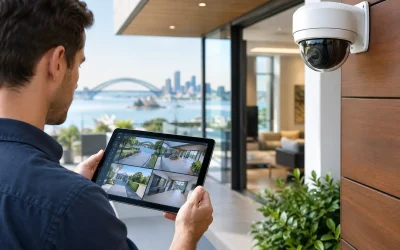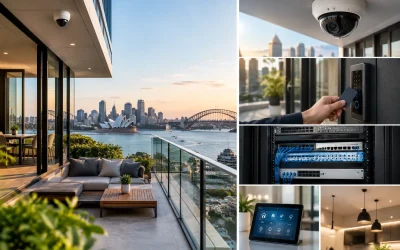



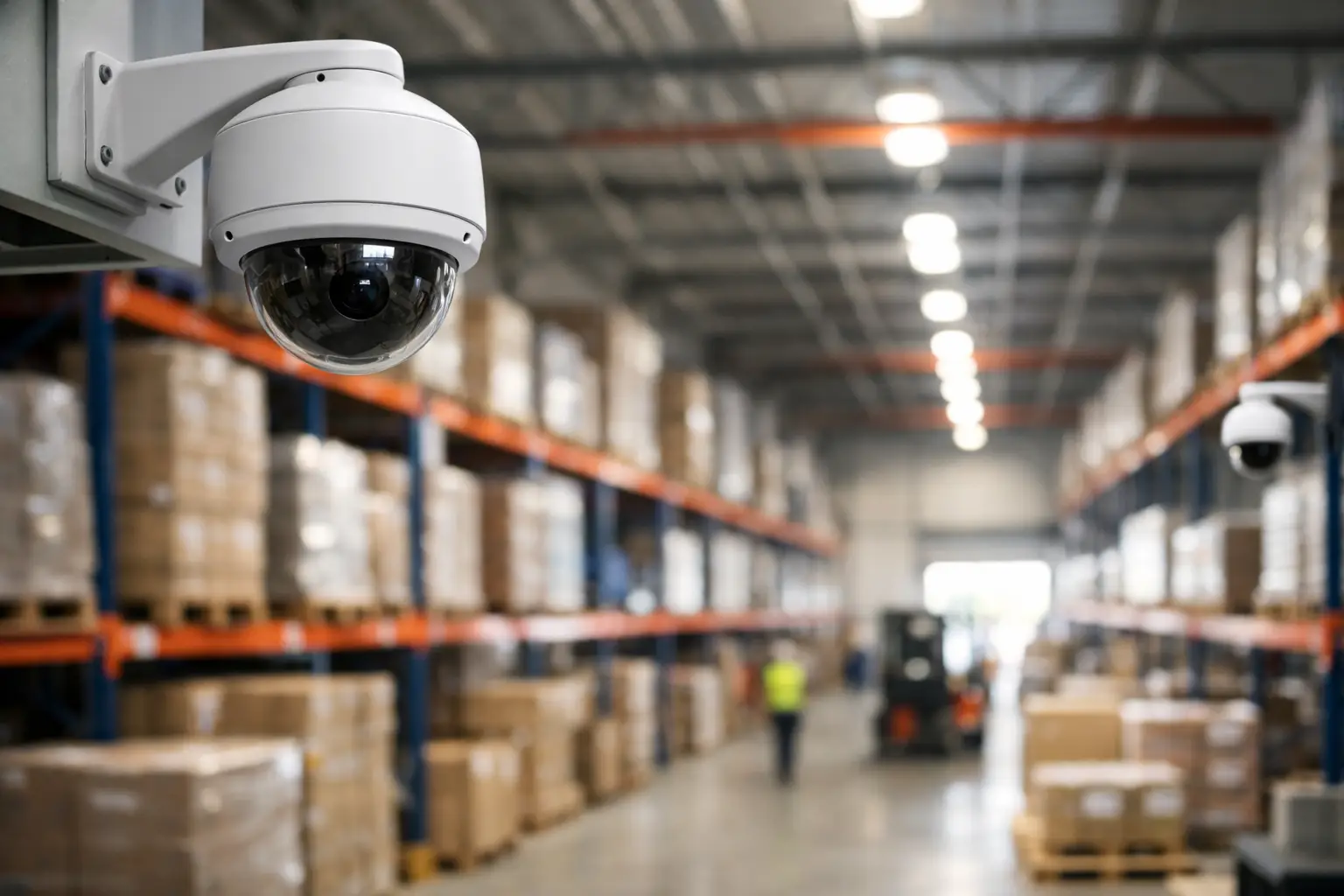
A useful warehouse CCTV example does more than show rows of cameras on a floor plan. It shows how video supports the way a facility actually operates: trucks arriving before sunrise, staff moving stock through aisles, contractors entering restricted zones, and managers needing clear evidence when an incident occurs. The best result is not the highest camera count. It is a reliable, connected system that gives the right people usable visibility without creating blind spots, network congestion, or hours of unusable footage.
A practical warehouse CCTV example
Consider a medium-sized distribution warehouse with a loading yard, two roller-door dispatch bays, pallet racking, a secure cage for high-value stock, staff parking, and a small office area. The site operates extended hours, with a mixture of permanent employees, delivery drivers, and contractors.
A well-designed CCTV system for this environment begins by separating the site into operational zones. Each zone has a different risk profile, lighting condition, and evidence requirement. The loading yard needs wide-area situational awareness and clear vehicle identification. Dispatch doors need close coverage of goods moving in and out. Warehouse aisles need reliable people and movement detection, while the high-value cage needs identification-grade video and access event verification.
This distinction matters because one camera model and one mounting height will not suit every part of the facility. A camera that provides a broad overview of a loading yard may be unable to identify a person at the far end of a warehouse aisle. Conversely, a tightly framed camera at a dispatch point can capture labels, handovers, and damaged goods but cannot replace a wide overview camera that explains the broader sequence of events.
The loading yard and perimeter
At vehicle entry and exit points, the design typically combines overview cameras with dedicated coverage for vehicle plates where required. Fixed cameras can monitor gates, pedestrian paths, fence lines, and parking areas, while a pan-tilt-zoom camera may provide an operator with the ability to investigate activity across a large yard.
The trade-off is straightforward: PTZ cameras are flexible, but they only look in one direction at a time. They work best as a supplement to fixed cameras, not as the primary record of activity. Fixed cameras maintain continuous coverage, while the PTZ supports active investigation after an alert or incident.
Good yard coverage also depends on lighting. Cameras cannot recover detail that has been lost to glare from headlights, deep shadows, or a poorly positioned floodlight. During design, camera views should be checked at the times that matter most, including early-morning deliveries and after-dark dispatch. Integrated electrical planning can improve outcomes by coordinating camera positions, external lighting, cable routes, and power protection from the start.
Dispatch bays and chain-of-custody evidence
Dispatch doors are often where CCTV provides its clearest operational value. A camera positioned above each bay can record the condition of incoming and outgoing goods, the presence of drivers, and the timing of handovers. Another camera may cover the roller door itself, providing context around whether a vehicle was present, when the door opened, and who entered the area.
For a site handling valuable, regulated, or disputed stock, this footage can support a chain of custody. The goal is not simply to prove that a shipment left the building. It is to provide a clear sequence: the vehicle arrived, the bay was opened, goods were transferred, the area was secured, and the vehicle departed.
This is where camera placement needs more care than a standard ceiling grid. Cameras should be positioned to avoid being blocked by raised roller doors, forklifts, or pallets staged beneath them. A site survey should also identify whether vibration from dock equipment could affect image stability.
Camera coverage inside the warehouse
Inside the warehouse, the priority is usually safe operations, loss prevention, and post-incident review. Ceiling-mounted turret or dome cameras can provide wide coverage across open areas, cross-aisles, packing stations, and forklift travel paths. Where ceiling heights are significant, the lens selection and mounting position become especially important. A camera installed too high may technically cover an aisle while producing footage that is insufficient for identification.
Racking creates another common problem. From one angle, long aisles can look fully visible. In practice, rack uprights, stacked pallets, and changing inventory can hide activity. For long or high-value aisles, cameras may need to be placed at both ends, or mounted at cross-aisle intersections, to preserve visibility as stock levels change.
Packing and returns areas often benefit from closer views than general warehouse zones. These are places where labeling errors, damaged goods claims, and stock discrepancies may originate. Clear views of benches, scales, staging points, and completed cartons can be more useful than broad footage of a large work area.
The high-value stock cage
A secure cage or controlled storeroom calls for a different standard. The camera should capture faces at the entry point, activity within the enclosure, and the door status. When CCTV is paired with access control, a door event can be matched with video evidence: who presented a credential, whether the door opened, how long it remained open, and whether another person entered behind them.
This integration is more effective than treating CCTV and access control as separate systems. If a manager receives an alert about an after-hours door opening, they should be able to review the corresponding camera view quickly rather than search through unrelated recordings. Platforms from established security manufacturers can support this type of event-based workflow, provided the system is designed, configured, and maintained correctly.
Network design is part of the security design
Cameras are network devices, and a warehouse CCTV system is only as dependable as the network behind it. A professionally planned system uses structured cabling, appropriate switching capacity, protected equipment locations, and a recording platform sized for the actual number of cameras, resolution, frame rate, and retention period.
It is tempting to specify high-resolution cameras everywhere. More resolution can be valuable, but it also increases storage and bandwidth requirements. The right approach is to use detail where detail is needed. Identification points, dispatch bays, and controlled doors may justify higher settings, while wide overview areas may require a different balance.
A managed network, such as a properly designed UniFi deployment, can help separate security traffic from general office devices and provide visibility into camera connectivity. Segmentation is particularly valuable where warehouse operations rely on wireless scanners, office systems, guest Wi-Fi, and access control at the same site. A camera outage should be visible and actionable, not discovered only after an incident.
Physical resilience matters as well. Recording equipment should be installed in a secure, ventilated location with suitable power protection. Critical network and CCTV infrastructure may need an uninterruptible power supply so short power disruptions do not cause recording gaps or leave doors and cameras offline during a restart.
Using AI analytics without relying on false certainty
Modern Dahua, Hikvision, and Bosch camera platforms can offer analytics such as people and vehicle classification, line crossing, intrusion zones, object detection, and smart search. Used well, these features reduce the time required to find relevant footage. Instead of reviewing eight hours of general movement, a manager can search for a vehicle entering a defined zone after a particular time.
Analytics are not a substitute for thoughtful camera design or operational procedures. Dust, insects, weather, forklift activity, and changing light can all affect alerts. An intrusion rule that is too sensitive will create nuisance notifications. A rule that is too broad may miss the event it was intended to capture.
The practical approach is to configure analytics around meaningful site behavior. An after-hours person entering the loading yard may warrant an immediate alert. Forklifts moving through the same zone during rostered operating hours should not. Rules should be tested over time and adjusted as the operation changes.
Recording retention and privacy decisions
Retention should be based on risk, incident discovery time, storage capacity, and applicable workplace and privacy obligations. Some facilities only need a short review window for routine operations. Others need longer retention because disputes, audits, or stock investigations may surface weeks later.
Longer retention is not automatically better if it creates a system that is expensive to maintain or difficult to search. It is more useful to have reliable recordings, correctly synchronized time stamps, documented user permissions, and a clear process for exporting evidence when needed. Access to footage should be limited to authorized personnel, with passwords, permissions, and software updates managed as part of ongoing support.
Designing response, not just surveillance
The strongest warehouse security systems connect detection to action. A verified after-hours alert might prompt a nominated manager to view cameras remotely, while a forced-door event could trigger an alarm response and send footage to the relevant team. During business hours, the same system may be used to investigate a safety concern or confirm a delivery dispute without interrupting warehouse operations.
Alpha Security Corp approaches these projects as connected infrastructure, combining CCTV with access control, alarm systems, structured cabling, networking, and licensed electrical work where the site requires it. That integrated approach is particularly valuable in warehouse retrofits, where adding cameras without reviewing power, network capacity, lighting, and door controls can create avoidable limitations.
A warehouse is not secured by cameras alone. It is secured by clear coverage, dependable recording, sensible alerts, and a response plan that people can follow when something actually happens.