


If you’re planning security for a new build, major renovation, office fit-out, or retrofit, the wired alarm vs wireless alarm question usually comes up early. It should. The choice affects more than sensors and keypads – it shapes reliability, future expansion, maintenance, and how well the alarm works with CCTV, access control, lighting, and automation.
A lot of alarm discussions get reduced to convenience versus performance. In practice, the right answer depends on the property, the construction stage, and how integrated you want the overall system to be.
Wired alarm vs wireless alarm: the real difference
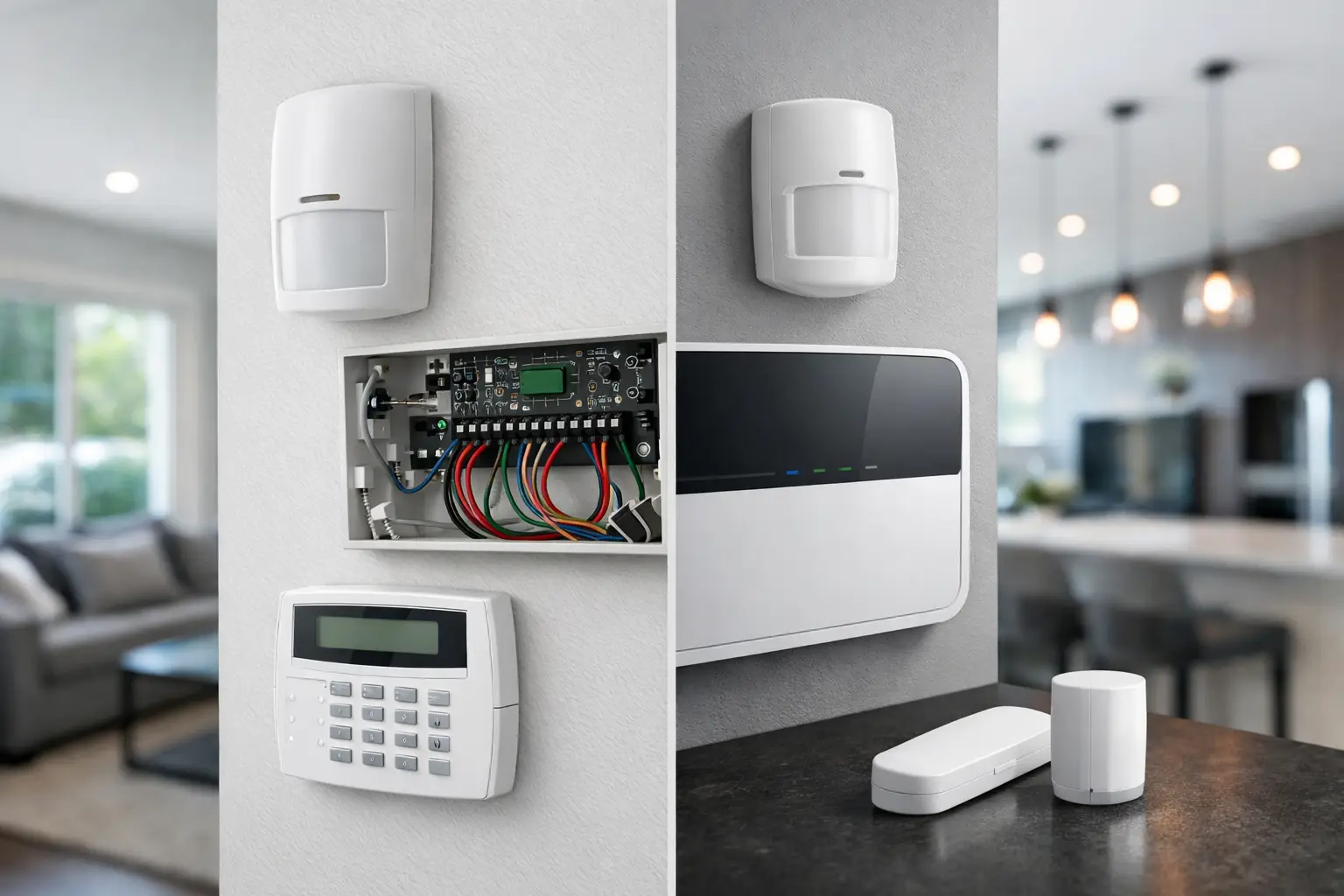
At the simplest level, a wired alarm uses physical cabling between the control panel and devices such as PIRs, reed switches, keypads, sirens, and expansion modules. A wireless alarm uses radio communication for some or all of those field devices, though it still needs power at the panel and often includes a mix of wired and wireless components.
That distinction matters because alarm systems do not exist in isolation. In a professionally designed property, the alarm may need to interact with CCTV recording, app control, back-to-base monitoring, smart locks, intercoms, lighting scenes, and structured networking. Once you look at the alarm as part of a broader system, the conversation becomes less about trend and more about infrastructure.
When a wired alarm makes more sense
Wired alarms remain the preferred option for many new homes, commercial spaces, and high-spec renovations because cabling gives you a very stable foundation. Hardwired detection devices are not dependent on battery cycles, and they are less exposed to the radio challenges that can appear in concrete construction, multi-level layouts, plant-heavy sites, and buildings with competing wireless traffic.
For larger homes and commercial properties, that stability becomes more valuable over time. A wired system can support a broad range of zones cleanly, including perimeter protection, internal detection, garage coverage, plant room monitoring, roller door contacts, panic buttons, and cabinet tamper inputs. If the site may later add access control, integrated intercoms, UniFi networking, or automation through platforms such as Apple Home or Home Assistant, having proper low-voltage infrastructure already in place gives you more options.
Wired systems also tend to be better suited to properties where long-term serviceability matters. Device locations are fixed and documented. Power is centrally managed. There is no ongoing battery replacement program across dozens of field devices. For strata common areas, offices, schools, warehouses, and larger custom homes, that can make maintenance more predictable.
None of that means wired is always better. It means wired rewards planning.
When a wireless alarm is the better choice
Wireless alarms are often the practical answer when finished surfaces need to stay intact or where running cable would be disruptive, expensive, or visually intrusive. That includes occupied homes, completed offices, heritage interiors, selective renovations, and smaller upgrades where the client wants strong security without opening walls and ceilings throughout the property.
A well-designed wireless alarm can perform very well, especially when device placement, signal paths, supervision, and panel location are handled properly. Modern wireless systems are far beyond the consumer-grade perception many people still have. Professionally installed solutions can offer encrypted communication, device supervision, mobile control, partitioning, and integration with monitoring services.
Wireless can also be useful where project timing is tight. If a site needs protection quickly, a wireless deployment may allow a faster path to commissioning than a fully cabled installation. For commercial tenancies with uncertain lease horizons, it can also provide flexibility if the security layout needs to adapt later.
The trade-off is that wireless introduces battery management and adds another layer of dependency to the system. Good devices report battery condition and communication status, but they still need periodic maintenance. In some properties, especially larger or more complex ones, that service cycle needs to be considered from the start rather than treated as an afterthought.
Reliability is not just about the alarm hardware
When clients ask which option is more reliable, the honest answer is that reliability comes from design as much as device type. A poorly planned wired alarm can be frustrating. A well-engineered wireless alarm can be excellent.
What usually separates a dependable system from an average one is the surrounding infrastructure. Panel location matters. Cable pathways matter. Wireless signal environment matters. Backup power matters. Network quality matters if app control, notifications, or integration are involved.
This is where a design-install approach becomes valuable. If the same project is also receiving CCTV, intercoms, access control, or a UniFi network, those systems should be planned together. For example, if camera analytics will verify alarm events, or if exterior lighting scenes will trigger on perimeter alarms, the security strategy needs to be coordinated from the beginning. Treating the alarm as a standalone item often creates compromises later.
Wired alarm vs wireless alarm for homes
For custom homes and major renovations, wired usually offers the cleanest long-term result. If walls are open, it makes sense to cable for reed switches, motion detectors, garage protection, sirens, keypads, and any future expansions while the opportunity exists. Even if certain devices end up being wireless initially, prewiring creates flexibility that is hard to replicate later.
This matters even more in homes that want a unified experience. If the alarm is expected to work alongside smart lighting, gate control, CCTV pop-ups, Apple Home scenes, or Home Assistant automations, the house benefits from infrastructure that was planned rather than improvised.
For finished homes, wireless often becomes the right call, particularly where owners want strong perimeter and internal protection without invasive construction. In those cases, the goal is not to force a wired solution into a completed building. It is to design a wireless system that fits the property properly and still leaves room for future integration.
Wired alarm vs wireless alarm for businesses
Commercial sites usually place a higher value on predictable maintenance, scalable zoning, and integration with broader building operations. Offices, retail tenancies, warehouses, and mixed-use sites often benefit from wired detection in critical areas, especially where system uptime and event reporting matter.
That said, wireless has a place in commercial work too. Temporary fit-outs, tenancy changes, after-hours additions, and hard-to-cable areas can make wireless devices the practical choice. In many business environments, the best solution is not purely wired or purely wireless. It is hybrid.
A hybrid design might use wired devices for the core shell of the premises and wireless devices for late-stage additions, problem areas, detached rooms, or expansion zones. This approach balances infrastructure strength with installation flexibility.
Cost should be viewed over the system life
Initial installation cost is only one part of the decision. Wired systems may cost more upfront when cabling labor is significant, particularly in retrofit settings. Wireless systems may reduce installation disruption and labor, but they introduce battery replacement and, in some cases, more ongoing service attention.
There is also the cost of future changes. A cheaper first step can become a more expensive long-term path if the system later needs to support more sensors, better partitioning, integrated access control, or automation workflows that were not considered early enough.
This is why serious projects benefit from asking a better question than “Which is cheaper?” The more useful question is “Which approach suits the building and the long-term plan?”
The best choice is often made before equipment is selected
The right alarm architecture usually becomes clear once a few project realities are defined. Is this a new build or a finished property? Are walls and ceilings open? Is the site residential, commercial, or mixed-use? Will the alarm need to integrate with CCTV, intercoms, access control, smart lighting, or automation? Is the priority minimum disruption, or maximum infrastructure for the future?
Once those answers are on the table, the wired versus wireless decision tends to become much more straightforward.
For many premium residential and commercial projects, the strongest answer is a system designed around the property rather than around a category. That may be fully wired. It may be fully wireless. Very often, it is a carefully planned hybrid that uses each method where it performs best.
If you’re building or upgrading security, the smartest move is to treat the alarm as part of the wider environment – not a standalone box on the wall. When the system is planned that way, you get something far more useful than a siren. You get security that fits how the property actually works.