


A front door that opens with a phone tap looks impressive for about five minutes. After that, what matters is whether the door unlocks every time, whether staff access can be changed without drama, and whether the system fits the rest of the property. That is the real test when comparing the best access control systems.
For most properties, the right choice is not the system with the longest feature list. It is the one that matches how the building is used, how many doors need to be managed, what level of audit trail is required, and how well it integrates with intercoms, alarms, CCTV, and the network behind it. A stylish reader on the wall means very little if the cabling, power, door hardware, and software were never planned properly.
What actually makes the best access control systems
The best access control systems do four things well. They authenticate the right people reliably, they keep operating under real-world conditions, they give managers clear control over permissions, and they fit into a broader security strategy instead of operating as an isolated island.
That last point is where many projects go wrong. Access control is often treated as a standalone purchase, when it should really be part of a wider building design. In a commercial site, that means aligning it with CCTV coverage, monitored alarms, intercom entry, and structured cabling. In a residence or high-end renovation, it may also need to work alongside smart locks, gate automation, Apple Home, Home Assistant, or lighting scenes triggered by occupancy and arrival.
A good system should also be comfortable with change. A single office can become a multi-tenant suite. A family home can add a detached garage, side gate, or staff entry. A strata building can shift from key management headaches to centrally controlled credentials. Scalability is not just about adding more doors later. It is about avoiding a dead-end platform that becomes painful to expand.
Start with the building, not the app
There is a tendency to compare systems by app screenshots and reader style. That is understandable, but it misses the engineering that determines whether the system will be dependable long term.
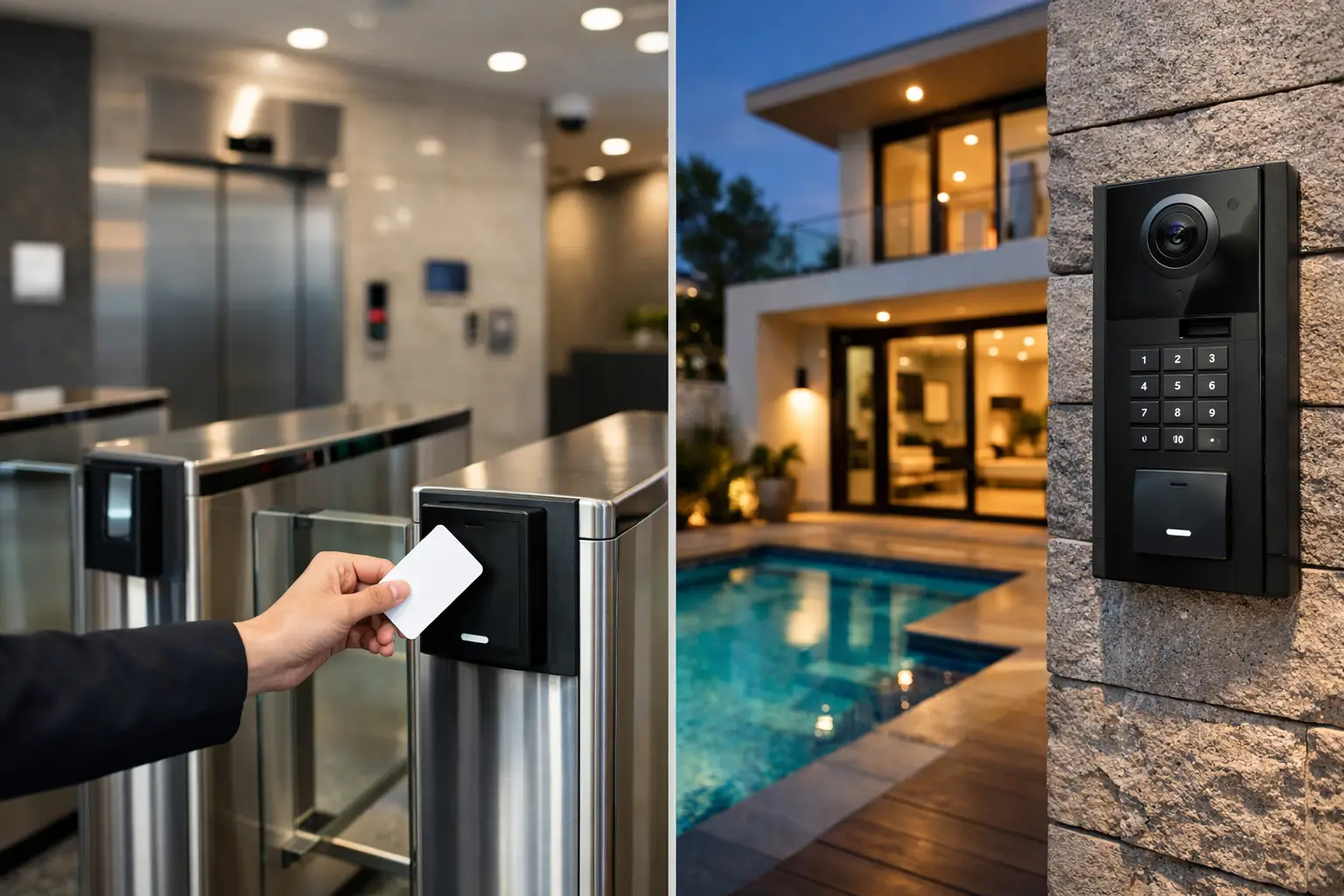
Door type matters. A glass office door, a fire-rated common area door, a warehouse roller door, and a residential pedestrian gate all have different hardware requirements. Reader choice matters too. Keypads, RFID fobs, Bluetooth credentials, PINs, mobile access, and intercom-based entry each suit different use cases. The best setup for a medical clinic is not necessarily the best one for a private residence or a loading dock.
Then there is the network. Cloud-managed access control can be excellent when the internet connection, switching, VLAN design, and power backup are properly considered. Platforms tied into UniFi networking or broader IP infrastructure can be easier to manage when the system has been planned by a team that understands both security and network performance. If those foundations are weak, even a strong software platform can feel unreliable.
Credentials: cards, phones, PINs, or biometrics?
Choosing a credential is often where owners start, but it should really follow the operational brief.
Cards and fobs are still practical because they are familiar, fast, and easy to issue. They work well in offices, schools, warehouses, and strata environments where many users need controlled entry. Their weakness is that they can be shared, lost, or cloned if low-security formats are used.
Mobile credentials are increasingly attractive, especially for premium residential projects and modern commercial spaces. They reduce physical key handling and make remote user management easier. The trade-off is user behavior. Some people disable Bluetooth, change phones frequently, or simply prefer a fob at a busy entry point. Mobile-first sounds efficient, but mixed credential environments are often more realistic.
PIN-based entry suits low-traffic internal doors, service spaces, or temporary access scenarios, though shared codes create accountability issues. Biometrics can make sense where identity assurance is critical, but they are not automatically the best option. They carry privacy considerations, can complicate user acceptance, and are often unnecessary for standard office or residential access.
In practice, the best access control systems support multiple credential types cleanly. That flexibility matters more than chasing a single trendy method.
Cloud vs on-premise access control
This is one of the most useful distinctions to make early.
Cloud-managed systems are attractive because they simplify remote administration. Adding a user, revoking access, checking door events, or receiving alerts can be done without being on site. For businesses with multiple locations or property managers handling several buildings, that convenience is hard to ignore.
On-premise systems still have a place, particularly in sites with strict IT policies, higher compliance requirements, or a preference for local control. They can offer deep customization and may suit larger or more specialized deployments. The trade-off is usually more involved administration and a greater need for ongoing support.
There is no universal winner here. A small professional office may benefit from cloud management more than a highly regulated facility would. A luxury home may want remote access for gates, delivery entry, and staff management, but still expect local fail-safe behavior if the internet drops. The right answer depends on risk tolerance, IT environment, and who will actually manage the system after installation.
Integration is where value compounds
Access control becomes much more useful when it is connected to the systems around it.
If a forced door event can pull the nearest CCTV footage, security response becomes faster. If an intercom can trigger managed entry rules instead of acting like a standalone doorbell, visitor access becomes cleaner. If access events can arm or disarm selected alarm areas, after-hours workflows become more practical. In a residence, gate entry, door release, lighting scenes, and notifications can all be coordinated in a way that feels natural rather than gimmicky.
This is where platform choice matters. Brands such as Akuvox are often considered where intercom and door entry need to sit closely together. Broader property ecosystems may involve Apple Home or Home Assistant for lifestyle control, but those integrations need boundaries. Critical security functions should remain dependable even if a convenience layer changes later. That split between core security and optional automation is part of good system design.
Best access control systems for different property types
A single-family residence usually benefits from a focused setup rather than a heavy enterprise platform. The priority is reliable control of the front gate, entry door, garage access, and possibly side or service entry. Owners often want simple credential options, remote visibility, and integration with intercoms, alarms, cameras, and smart home routines. The system should feel easy to live with, not like commercial software awkwardly dropped into a home.
For offices and commercial suites, audit trails and staff administration become more important. The ability to create schedules, assign access by role, and review events quickly matters day to day. Multi-door management, visitor access, after-hours control, and integration with CCTV usually carry more weight than residential-style app convenience.
Strata and multi-tenant environments need a different balance again. Shared entries, contractor management, resident turnover, and common-area control all put pressure on administration. A system that looks fine at one front door can become frustrating across lobbies, parking areas, plant rooms, elevators, and shared amenities. In these settings, scalable credential management and dependable support are just as important as hardware quality.
Industrial and warehouse sites often need hard-wearing devices, better perimeter control, and more careful treatment of shift access, delivery points, and restricted zones. Environmental conditions, vehicle gates, and long cable runs can shape the design as much as software features do.
Common mistakes when choosing a system
The first mistake is buying for appearance instead of use case. Clean readers and attractive apps matter, but they are not the core of system performance.
The second is underestimating door hardware. Electric strikes, maglocks, request-to-exit devices, fire compliance, and door closers are not side issues. They are the physical layer that determines whether access control works smoothly or becomes a maintenance problem.
The third is ignoring integration from the start. If CCTV, alarms, intercoms, and networking are planned separately, the final result is usually harder to manage. This is why integrated providers tend to deliver better outcomes on complex homes, offices, and new builds. The value is not only in installation. It is in coordinated design.
Finally, many owners choose a platform without thinking about who will support it in three years. Firmware updates, credential changes, expansions, hardware replacement, and tenant turnover all matter. A good system should be supportable, not just sellable.
How to evaluate access control the right way
A useful selection process starts with a few grounded questions. How many doors are being controlled now, and how many later? Who needs access, and how often does that list change? Is there a reception desk, a monitored alarm, an intercom, or a CCTV system that should work alongside it? Does the site need cloud visibility, or is local control preferred? Are there compliance, fire, or tenancy issues that affect the door hardware?
From there, compare platforms on practical terms. Look at credential flexibility, event reporting, support for schedules and temporary access, integration pathways, and the quality of the hardware ecosystem around the controller. Ask how the system behaves during power loss, network outages, and future expansion. Those answers are usually more revealing than feature brochures.
For properties in Sydney and across NSW where access control needs to fit within a wider security, electrical, and automation scope, that integrated planning stage is often the difference between a clean result and a patchwork one. Alpha Security Corp approaches these projects with that broader view because doors, networks, intercoms, lighting control, and security events rarely perform well when they are designed in isolation.
The best system is usually the one you stop thinking about after handover. It works, it scales, it is easy to manage, and it fits the way the property actually runs.