


A front entry is often where a property’s security design either becomes useful or falls apart. A visitor arrives, a delivery needs access, a resident is away, or a staff member needs to admit a contractor. The right system should make that decision clear, secure, and easy to manage. When comparing intercom vs smart doorbell systems, the real question is not which device has the better camera. It is which approach fits the building, the people using it, and the wider security infrastructure.
A smart doorbell can be an effective addition to a single-entry home. A professionally specified intercom, however, is usually designed to do more: verify visitors, communicate reliably, release doors or gates, support multiple users, and integrate with access control, CCTV, alarms, and automation. The distinction matters most when a property has more than one entrance, a motorized gate, multiple occupants, or operational security requirements.
Intercom vs Smart Doorbell Systems: The Core Difference
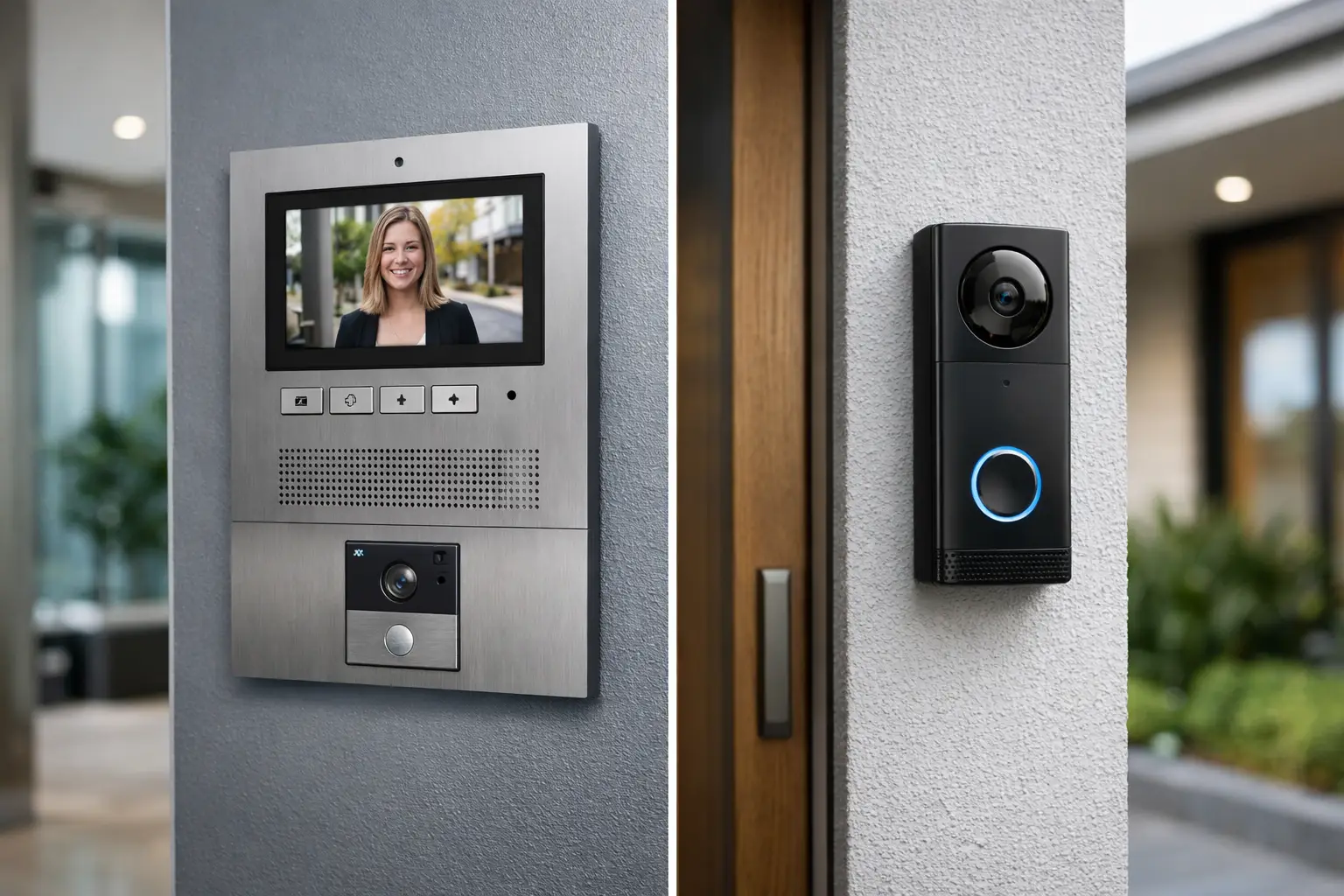
A smart doorbell is primarily a visitor notification device with a camera, microphone, speaker, and mobile app. When someone presses the button or triggers motion detection, the system sends an alert to a phone or connected display. Some models can also work with smart locks or provide recorded video clips.
An intercom system is an entry-management platform. It may include a door station with video and audio, indoor monitors, mobile calling, gate or door release, access credentials, directory functions, and integration with electronic locks. Systems from platforms such as Akuvox can be designed around a residence, strata building, office, warehouse, or mixed-use site rather than around a single consumer app.
That does not make every intercom the automatic choice. A homeowner who only needs to see and speak with visitors at one existing front door may be well served by a smart doorbell. But once access needs to be controlled across gates, side entries, lobbies, or multiple units, an intercom provides a more appropriate foundation.
Where Smart Doorbells Make Sense
Smart doorbells work best in contained situations. A single-family home with one front entrance, strong Wi-Fi coverage, and no requirement for a wired door release can benefit from fast visitor alerts and remote conversation. They can also be useful as a secondary camera point when integrated thoughtfully into a broader home automation environment.
Their appeal is convenience. Residents can answer from a phone, check who rang while away, and receive a visual record of activity at the entrance. When paired with Apple Home or Home Assistant, the notification experience can be made more consistent with other connected devices in the home.
The trade-off is that many smart doorbells are built as standalone products. Their reliability can depend heavily on Wi-Fi signal quality, cloud services, battery condition, app permissions, and vendor account access. Those constraints may be acceptable at a simple entry point, but they are less suitable where access decisions affect staff, tenants, deliveries, or building operations.
A smart doorbell also does not automatically solve gate access. Opening a pedestrian gate, driveway gate, or electric strike safely requires the correct low-voltage wiring, relay control, power supply, safety configuration, and often licensed electrical work. Adding these functions after the fact can become more complicated than planning a proper entry system from the start.
When a Video Intercom Is the Better Investment
A video intercom is generally the stronger choice when entry access is part of the security plan rather than just a notification. At a residence, that may mean calling indoor touchscreens and mobile devices, viewing a visitor at the front gate, and releasing the gate only after verification. At a commercial property, it may mean directing calls to reception, designated teams, or after-hours staff while maintaining a record of entry activity.
The benefits become clearer in properties with several users. A family may want separate call destinations for household members. A business may need different permissions for reception, managers, cleaners, and contractors. A strata property may need a directory, apartment calling, shared gate access, and a serviceable system that can be managed as occupants change.
A well-designed intercom can also be hardwired over structured cabling or supported by a professionally designed network. This reduces reliance on marginal wireless coverage at exterior walls or gates, where signal quality is often poorest. A UniFi network, for example, can provide stronger visibility into device connectivity, VLAN separation, power-over-Ethernet switching, and network health than an unmanaged collection of wireless devices.
Hardwiring does not mean losing mobile convenience. Modern intercom platforms can provide calls to indoor monitors and smartphones while retaining a local, building-focused system design. The difference is that mobile access becomes one control method, not the only path for answering the door.
Access Control Changes the Decision
The most important dividing line in intercom vs smart doorbell systems is usually access control. If a visitor only needs to be seen and spoken to, either approach can work. If they need controlled admission, the design must consider the locking hardware, user permissions, emergency egress, backup power, and audit requirements.
For homes, an intercom can work with pedestrian gates, vehicle gates, electric strikes, maglocks where appropriate, keypad access, fobs, cards, or mobile credentials. The system can be configured so that a resident can verify a visitor at the gate and release only the relevant entry point.
For commercial and strata sites, access control adds a layer of accountability. Staff credentials can be added or removed, doors can follow schedules, and administrators can review entry events. A visitor intercom should support this system rather than sit beside it as an unrelated device. That is particularly valuable for medical offices, schools, warehouses, and managed buildings where a front door is an operational boundary.
It also requires careful design. Not every lock type suits every door, and not every door should be remotely released. Fire and life-safety requirements, door construction, accessibility, and local code obligations all affect the correct solution. This is where security, electrical, and cabling expertise need to work together.
Network Reliability and Privacy Are Design Requirements
Both smart doorbells and IP intercoms are networked devices, so the network deserves the same attention as the camera or door station. A premium entry system cannot compensate for poor Wi-Fi coverage, an overloaded router, unsuitable outdoor cabling, or inadequate power.
For an intercom at a front gate, structured cabling and power-over-Ethernet are often preferable where feasible. They provide a stable connection, simplify power delivery, and allow the device to sit on a defined network segment. For retrofits where cable routes are limited, a wireless design may still be practical, but it should be tested at the actual installation location rather than assumed to work from inside the house.
Privacy deserves equal attention. Entry cameras capture visitors, neighbors, delivery personnel, and staff. Property owners should understand where footage is stored, who can access live video, how recordings are retained, and whether user accounts can be protected with strong authentication. For businesses and strata properties, clear policies around recordings, permissions, and administrative access are part of responsible system management.
Integration Should Be Useful, Not Decorative
The strongest entry systems reduce friction without creating unwanted automation. A video intercom can trigger a useful response when someone arrives: an indoor display can show the call, exterior lighting can improve visitor visibility after dark, and a gate can be released after authorization. In a well-planned home, Apple Home or Home Assistant may present intercom status alongside cameras, lighting, and gate controls.
The key is to avoid treating integration as a collection of tricks. Automatically opening a gate because a phone is nearby may be appropriate in some private residential settings, but it is rarely right for a shared or commercial entrance. Automation should reinforce verification and user intent, not bypass them.
For new builds and major renovations, planning the entry system early allows cable pathways, gate controls, indoor monitor locations, networking, and electrical provisions to be coordinated before walls and landscaping are finished. On an existing property, a site assessment can identify whether a wired intercom, a networked door station, or a carefully positioned smart doorbell is the most practical route.
Choosing the Right System for the Property
Choose a smart doorbell when the requirement is straightforward: one entry, a small number of users, reliable Wi-Fi, and a need for visitor alerts rather than managed access. It can be a sensible component of a connected home when its network and privacy requirements are properly considered.
Choose a video intercom when the entrance includes a gate, locked door, multiple users, multiple units, staff workflows, or a need to integrate with access control and CCTV. It is also the better path when the property needs indoor answering stations, directory calling, credentials, auditability, and a system that can grow with the site.
For properties where security, networking, electrical infrastructure, and automation overlap, the best result comes from designing the entry experience as part of the whole environment. A front door or gate should not become the weak point between otherwise well-planned systems. It should be one clear, dependable point of control that people can use confidently every day.