


A lockdown is not a button, a siren, or a door schedule. It is a coordinated emergency procedure that depends on people understanding what to do and technology responding predictably under pressure. This school lockdown system guide explains how schools can plan an integrated setup around their established emergency procedures, rather than assembling disconnected devices that create confusion when seconds matter.
The best result is not a campus that feels fortified. It is a campus where authorized staff can communicate clearly, secure the appropriate areas quickly, verify conditions through reliable information, and support first responders without compromising day-to-day learning, accessibility, or fire-life-safety requirements.
Start With the Emergency Procedure, Not the Equipment
Every school site has different risks, building layouts, student needs, and response requirements. A single-building elementary school, a multi-level high school, and a shared community education facility should not receive the same lockdown design by default.
Begin with the procedures already developed by school leadership, district safety teams, emergency services, and legal or compliance advisers. Define what constitutes a lockdown, who can initiate it, which staff must be notified, how classrooms respond, and how the school communicates with emergency responders and families. Technology should support these decisions. It should not invent them.
This is also where terminology needs to be clear. A lockdown may involve securing classrooms and limiting movement. Other events may call for a shelter-in-place, evacuation, restricted access, or a targeted area response. If one button triggers the same action for every event, the system may be simple to install but poorly matched to real operational needs.
A professional site assessment should map entries, administrative areas, classrooms, gates, parking zones, visitor paths, assembly areas, and potential communication dead spots. It should also identify what the existing electrical infrastructure, cabling, network, door hardware, and fire systems can safely support.
The Core Layers of a School Lockdown System
A dependable lockdown system is a connected set of layers. Each layer has a defined job, and each should continue operating sensibly if another layer is impaired.
Initiation and emergency alerts
Staff need a clear, accessible way to initiate an approved emergency response. Depending on the school’s procedures, this might include fixed duress buttons in administrative offices, discreet activation devices at reception, monitored alarm inputs, or authorized controls within a secure management application.
Activation must produce an unambiguous result. Designated personnel may receive immediate notifications, while predefined messages can be sent through appropriate alert channels. Visual indicators, audible alerts, paging, text-based notifications, and digital signage can all have a role, but the right combination depends on the building and the people using it.
Audible alerts alone are not enough. They may not reach noisy areas, may be inappropriate for some events, and may not effectively support people with hearing impairments. Equally, an alert message must be concise enough to understand immediately. The system should use agreed language that staff have practiced, not vague or overly technical wording.
Access control and door behavior
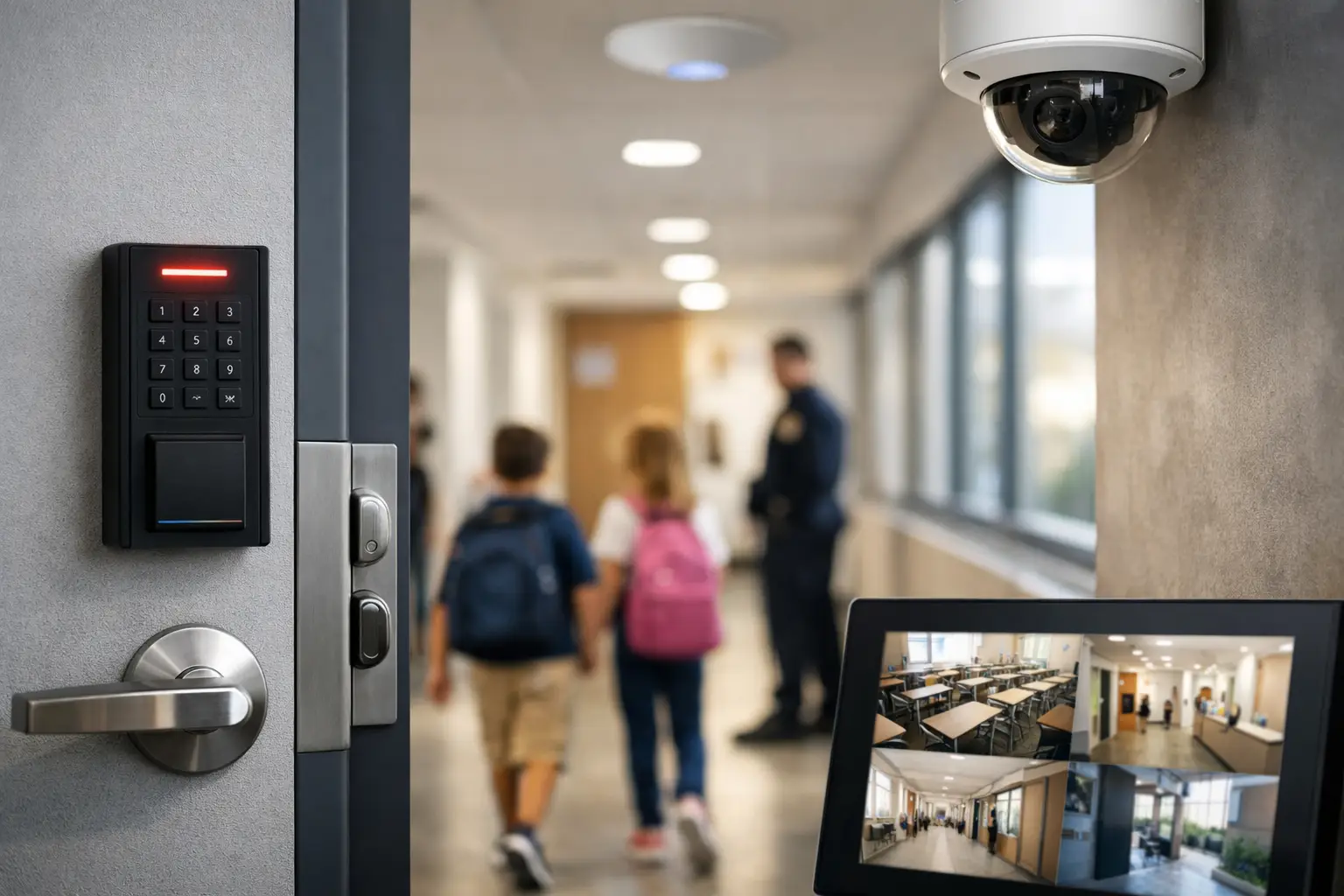
Access control is often the most misunderstood part of lockdown planning. The goal is not simply to lock every door. Schools must preserve safe egress, meet applicable building and fire requirements, and avoid creating barriers that delay evacuation during another emergency.
A properly designed system defines door behavior by location and event type. Exterior entries may be secured to prevent unauthorized access, while classroom doors can be configured according to approved life-safety hardware and local requirements. Staff credentials may retain access where procedures allow, and administrators can receive immediate confirmation of door states.
This is why the electronic system, locking hardware, door frames, power supplies, emergency egress, and fire alarm interfaces need to be designed together. A capable access control platform cannot correct unsuitable door hardware or an unreliable power design. It also cannot replace clear staff procedures for securing rooms.
CCTV for verification, not surveillance theater
CCTV provides situational awareness before, during, and after an incident. Cameras at primary entrances, reception, corridors, gates, perimeter approaches, and key common areas can help authorized personnel assess what is occurring and direct first responders to relevant locations.
Camera placement matters more than camera count. A camera that captures faces poorly in backlit entryways or loses detail at night may add little value. Professional design considers viewing angles, lighting, retention requirements, privacy expectations, coverage overlap, and secure recording infrastructure.
AI-assisted analytics can assist with specific operational tasks, such as detecting a person in a restricted perimeter area or identifying unusual after-hours movement. However, analytics should be treated as a supplementary alerting tool, not an autonomous decision-maker. Schools need human verification, tested escalation paths, and appropriate governance for any feature that processes sensitive video data.
Communications that work when the campus is busy
Emergency communication needs more than a PA system. A school may require a combination of intercoms, mass notification, administrative alerts, classroom communications, and mobile notifications for defined staff groups. Each channel has limitations, so a layered design is generally more dependable than relying on one method.
Network quality is central to this layer. If camera streams, access control events, VoIP intercoms, and administrative traffic all compete on an unmanaged network, performance can deteriorate at exactly the wrong time. Structured cabling, properly segmented switching, battery-backed network equipment, and centrally managed platforms such as UniFi can help create a more reliable foundation.
For larger sites, consider how communications continue during an internet outage or a localized power failure. Local operation, battery backup, and monitored fault reporting are not glamorous specifications, but they are often what separates a functioning security system from a collection of installed equipment.
Design for Normal School Operations Too
A lockdown system that disrupts arrivals, visitors, maintenance, or after-hours programs will eventually be bypassed. The strongest designs improve everyday control while remaining ready for emergencies.
A managed visitor entry point, for example, can allow reception staff to verify and communicate with visitors through an intercom before granting access. Credentialed access can give faculty, facilities teams, and approved contractors the access they need without leaving doors unsecured. Audit trails can assist with incident review and operational accountability.
Integration should be purposeful. Access control can trigger relevant camera views at a security workstation. An intercom call can display the associated entry camera. A verified alarm event can notify designated staff and provide a documented timeline. These connections reduce the number of systems staff must interpret during a stressful event.
Not every feature needs to be automated. Highly complex workflows can create failure points and make staff hesitant to act. The right design balances automation with manual overrides, clear authority, and controls that remain understandable after staff turnover.
Testing, Training, and Maintenance Are Part of the System
Installation is only the beginning. A school lockdown system should be tested against realistic scenarios and reviewed whenever procedures, building layouts, staffing, or student needs change.
Testing should confirm that alert messages reach the intended groups, doors behave as designed, cameras record usable footage, backup power operates, and system events are logged accurately. It should also confirm that safety interfaces operate as required. These checks should be coordinated carefully so testing does not cause unnecessary alarm or interfere with school operations.
Staff training should focus on decisions they may need to make, not just which buttons exist. Reception personnel may need different training from teachers, facilities staff, or administrators. Substitute teachers and new employees need a practical onboarding process as well. Drills should follow applicable policies and be conducted with attention to student wellbeing, accessibility, and trauma-informed practice.
Maintenance is equally important. Door closers drift out of alignment, batteries age, network switches fail, cameras become obscured, and software permissions accumulate over time. Scheduled inspections, firmware management, credential reviews, and documented service records keep the system dependable long after handover.
Choosing an Integrated Delivery Partner
Schools benefit from working with a provider that can coordinate security design with licensed electrical work, structured cabling, networking, door hardware, and ongoing service. Separating these scopes among multiple contractors can work, but it increases the risk of unclear responsibilities at interfaces such as power supplies, fire integration, network capacity, and controlled doors.
The right partner will ask detailed questions before proposing equipment. They should be able to explain why a specific access control architecture, CCTV platform, intercom solution, or network design fits the site, along with the limitations and maintenance obligations. They should also provide a clear handover process, administrator training, drawings, programming records, and support arrangements.
Alpha Security Corp approaches these projects as connected environments, where security, electrical infrastructure, and network reliability are planned to work as one. For schools, that integration supports a practical objective: clear procedures backed by technology that staff can trust when it counts.
A well-designed lockdown system does not promise to eliminate every risk. It gives a school a more reliable way to act on its prepared procedures, communicate with its people, and maintain control of critical access points when calm, coordinated action is needed most.