



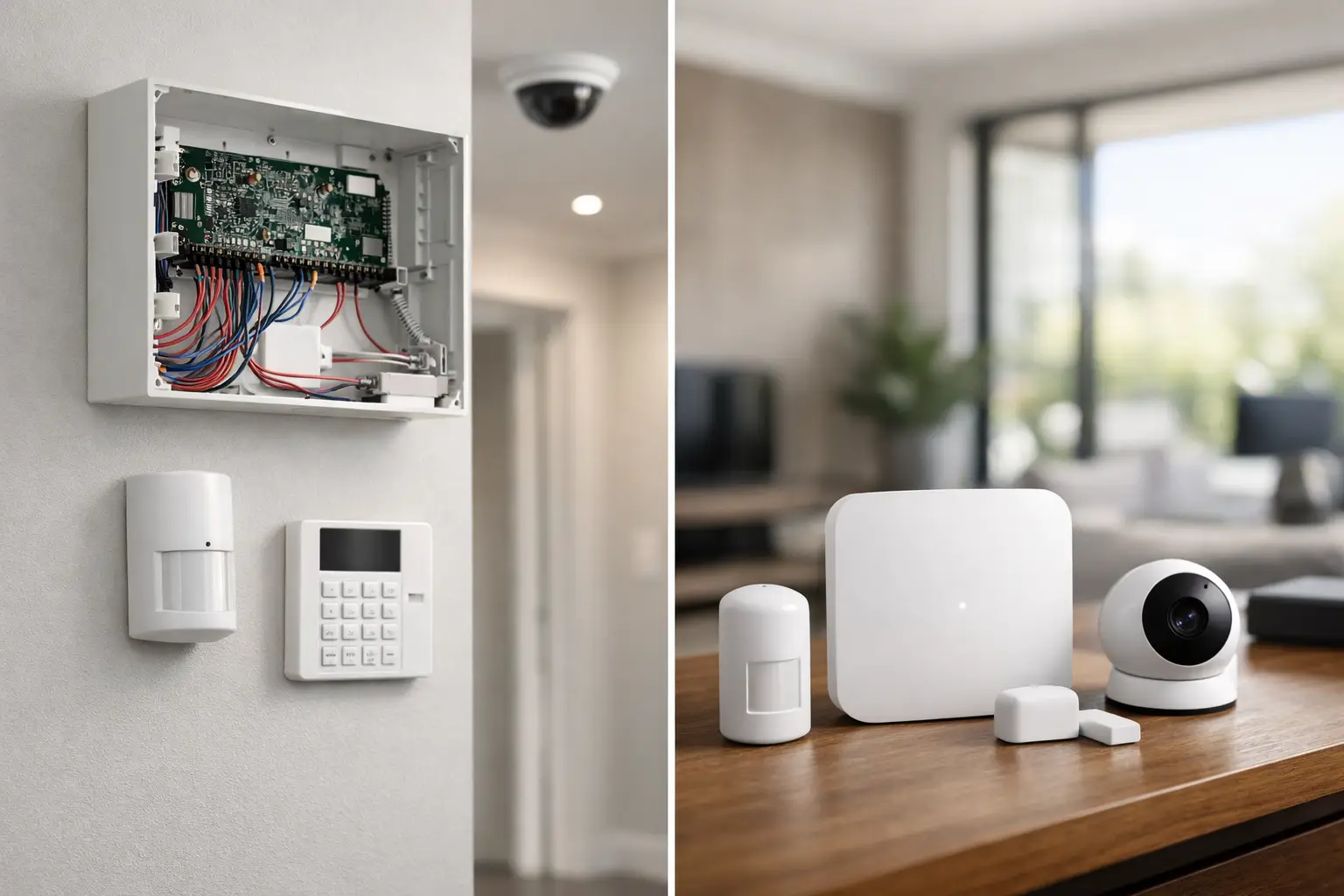
An alarm system is only as dependable as the infrastructure behind it. A sensor may look identical on the wall, but its method of communication, power source, installation path, and relationship with the rest of the property can be very different. When comparing wired vs wireless alarm systems, the right answer is rarely about choosing the newest technology. It is about selecting a system that suits the building, the risk profile, and the way the property will operate over time.
For a new home, major renovation, commercial fit-out, or site with accessible ceiling and wall cavities, a wired design often creates the strongest long-term foundation. For an occupied home, heritage building, finished office, or targeted security upgrade, wireless devices can provide a capable and practical path without extensive construction work. The best installations often use both.
Wired vs Wireless Alarm Systems: The Core Difference
A wired alarm system connects detection devices to an alarm panel through dedicated low-voltage cabling. Door contacts, motion detectors, glass-break sensors, keypads, sirens, and other devices receive power and communicate through physical cable runs. The panel is usually supported by battery backup, so the system can continue operating during a mains power outage.
A wireless alarm system uses radio communication between devices and the alarm panel or receiver. Sensors are generally battery-powered, while the panel and external siren have their own power arrangements. Modern professional wireless systems supervise device status and report low batteries, tamper conditions, and communication faults, making them far more capable than earlier generations of wireless security equipment.
Neither approach is automatically better. Wired systems prioritize permanent infrastructure and predictable communications. Wireless systems prioritize installation flexibility and reduced disruption. The decision becomes clearer when the property itself is considered.
Why Wired Systems Remain the Benchmark for New Builds
If walls are open and cable pathways can be planned properly, wiring alarm devices is usually the preferred approach. Cabling removes the need to regularly replace batteries across a large group of sensors, and a dedicated cable path is not affected by radio congestion, building materials, or changes to the wireless environment.
This matters in larger homes and commercial sites. Reinforced concrete, foil insulation, steel framing, lift cores, plant rooms, and dense services can all affect radio performance. A professionally designed wireless system can account for these conditions, but hardwired connections remain more predictable when a property has challenging construction or a broad footprint.
Wired alarms also support a cleaner integration strategy. During construction, alarm cables can be coordinated alongside structured cabling, CCTV, access control, intercom, Wi-Fi access point locations, smart lighting controls, and electrical works. Instead of treating security as a late-stage addition, the system becomes part of the property’s underlying technology plan.
For example, a perimeter alarm can be designed alongside motorized gates, video intercoms, access-controlled doors, external cameras, and lighting scenes. A security event may trigger selected lights, notify authorized users, or provide a clearer operational response without relying on a collection of disconnected apps. That is particularly valuable for properties using platforms such as Apple Home, Home Assistant, UniFi networking, DALI-2 lighting, or Zen Control.
The practical limits of a wired installation
The strength of wired security comes with a construction requirement. Running cable through a completed home can involve ceiling access, wall penetrations, patching, repainting, and careful coordination with existing electrical and plumbing services. In a premium finished interior, the disruption may outweigh the benefit of wiring every device.
A wired system also needs disciplined design. Cable routes, panel location, equipment cabinets, backup power, and future expansion points should be considered before finishes are installed. Poorly planned wiring is still poor infrastructure, even when the alarm hardware itself is high quality.
When Wireless Alarm Systems Make More Sense
Wireless alarm systems are often the right choice where cabling would be impractical or unnecessarily invasive. This includes occupied homes, retail spaces that cannot close for extensive works, strata common areas, renovated properties with limited cavity access, and sites where a focused security upgrade is required quickly.
Professional wireless devices can provide reliable perimeter and internal protection when they are selected, positioned, and tested correctly. The key is avoiding the assumption that wireless means install-and-forget. Every device needs a verified radio path, correct mounting location, battery maintenance plan, and ongoing supervision through the alarm panel or monitoring service.
Wireless can also be useful as part of a staged project. A homeowner may start with perimeter protection, selected internal detection, and monitored communications, then add CCTV, access control, structured cabling, or smart lighting as renovation work progresses. In this situation, wireless security protects the property now without preventing a more comprehensive wired infrastructure plan later.
Battery maintenance is a real operational consideration
Wireless sensors typically have long battery life, but batteries are still a maintenance item. A property with many contacts, motion sensors, panic devices, and specialty detectors needs a clear process for responding to low-battery alerts before a device becomes unavailable.
For a single-family residence, this may be a straightforward scheduled service task. For commercial or strata environments, battery status should be managed as part of an ongoing maintenance program with clear responsibility. The question is not whether batteries are inconvenient. It is whether the property team has a dependable process to maintain them.
Reliability Depends on More Than the Sensor Connection
It is easy to frame the comparison as cable reliability versus wireless reliability. In practice, alarm performance also depends on panel power, backup batteries, communications, device placement, and the quality of installation.
A wired alarm still requires a properly sized backup battery and protected communications path. A wireless alarm still requires a stable radio design and regular supervision. Both systems benefit from dual-path signaling, where appropriate, using more than one method to communicate alarm events to a monitoring center or authorized users. A panel connected through a primary IP path and a cellular backup path is less exposed to a single communications failure.
The same principle applies to network-connected security systems. A reliable UniFi or professionally managed network can support integrated services, but alarm signaling should be planned with resilience in mind rather than treated as another ordinary device on the Wi-Fi network. Dedicated equipment locations, battery backup, surge protection, and documented network configuration all contribute to dependable operation.
Integration Changes the Decision
An alarm panel should not sit apart from the rest of the building if the property needs security, automation, access control, and visibility to work together. The specific panel and platform matter because not every system offers the same level of integration, reporting, remote management, or expansion capability.
In a residential setting, a well-designed system can coordinate alarm states with lighting, gates, cameras, and selected automation routines. Arming the property at night might confirm that external doors are secure, switch off designated areas, and preserve practical pathways for late-night movement. An alarm event can bring relevant cameras to attention and activate exterior lighting without turning the home into a confusing collection of alerts.
For commercial sites, integration may connect alarm partitioning with access control schedules, CCTV verification, restricted areas, and monitored response procedures. A warehouse may require different behavior for office areas, loading zones, and perimeter doors. A medical or education site may need access and alarm behavior that matches changing occupancy patterns. These are design questions, not simply device-selection questions.
A Hybrid System Is Often the Most Practical Answer
The choice does not have to be entirely wired or entirely wireless. Hybrid alarm systems combine hardwired devices where cabling is available or essential with wireless devices where access is difficult. This is often the most sensible approach for extensions, staged renovations, or commercial premises where some areas are being refitted while others remain operational.
A hybrid design can hardwire key perimeter points, external sirens, keypad locations, and critical detection areas while using wireless contacts or detectors in finished rooms. It gives the system room to adapt without compromising the value of permanent cabling where it can be installed properly.
This approach also helps future-proof the property. If a renovation is planned in stages, the initial work can include spare conduits, accessible cable pathways, and a correctly located security cabinet. Wireless devices can bridge the gap until the next stage of work, rather than becoming a permanent substitute for infrastructure that was never planned.
Questions to Resolve Before Choosing
The best alarm design starts with a site assessment, not a product brochure. Consider how the building is constructed, whether ceilings and walls are accessible, how many protected openings are required, and whether the property will be renovated or expanded in the next few years.
It is equally useful to define what should happen after an alarm event. Does the site need back-to-base monitoring, video verification, designated user notifications, lighting response, access control actions, or separate arming areas? A small home with one entry point has different requirements from a multi-tenant commercial site, but both benefit from a clear response plan.
For new builds and major renovations, Alpha Security Corp typically treats alarm wiring as part of the broader low-voltage and electrical design process. That allows security, CCTV, intercoms, networking, and automation to be planned as one coordinated environment rather than added after finishes are complete.
The right system is the one that remains easy to manage years after installation. Choose wired infrastructure where the building gives you the opportunity, use professional wireless devices where they genuinely improve the project, and make sure the alarm has a clear role in the wider security and technology plan.