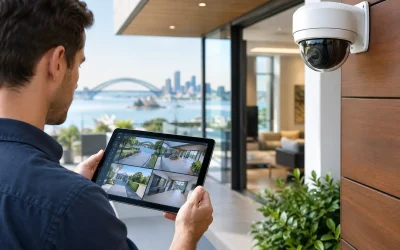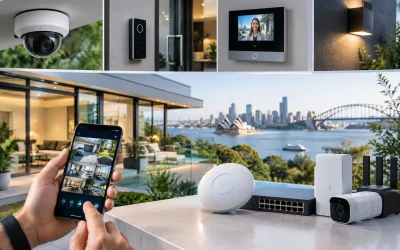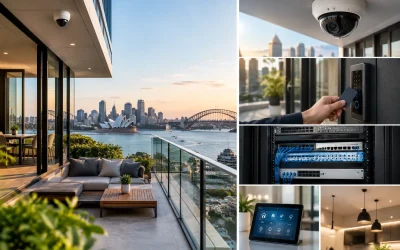



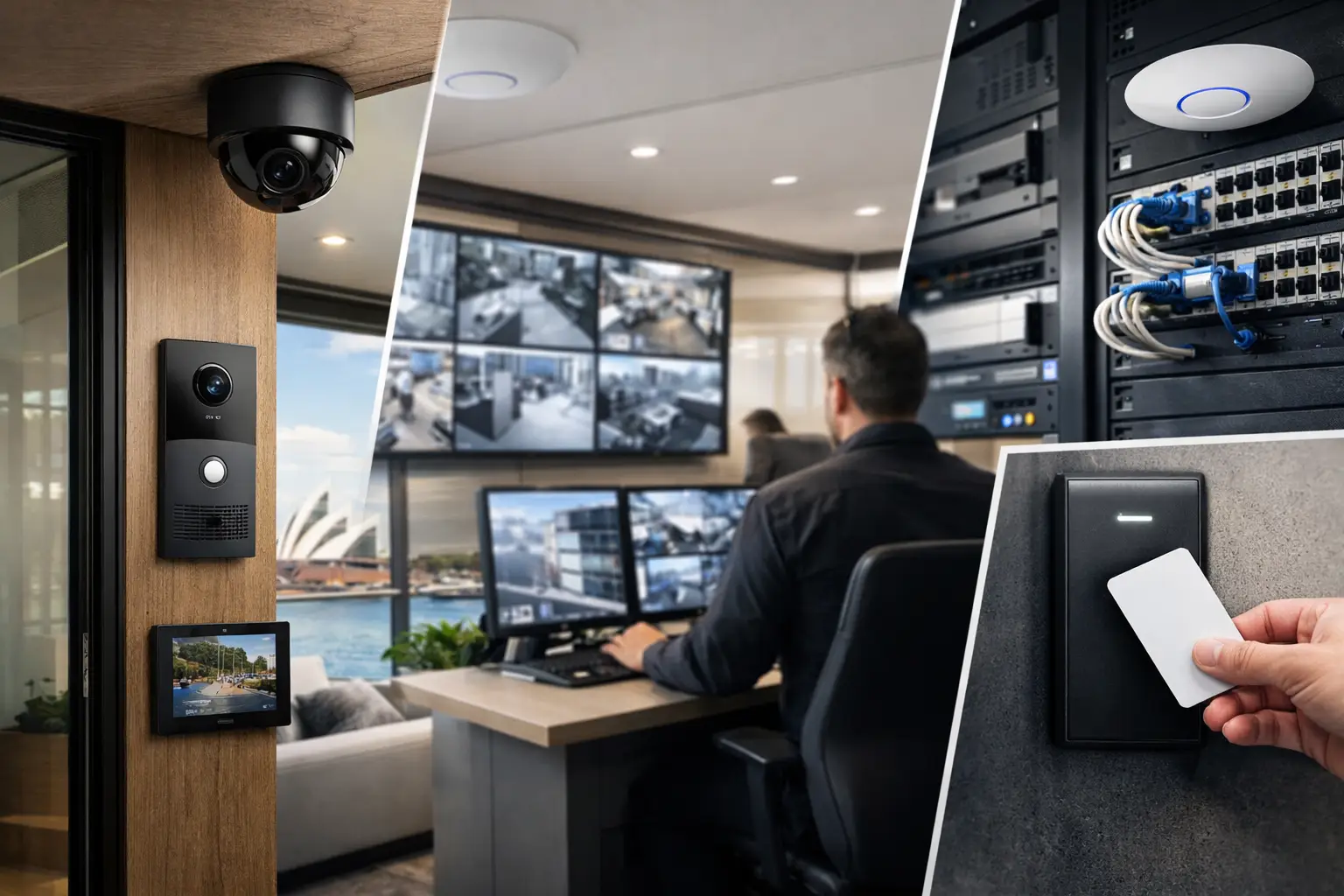
A forced door at 2:00 a.m. should do more than trigger a siren. It should identify the affected area, present the relevant camera view, notify the right people, record the event, and support a measured response. That practical expectation defines the future of integrated building security: connected systems designed around how a property is actually used, rather than a collection of devices installed in isolation.
For homeowners, building teams, strata stakeholders, and commercial operators, the shift is less about adding more technology and more about making core systems work together reliably. Security, lighting, networking, electrical infrastructure, access control, intercoms, and automation are becoming parts of one operational environment.
Security is becoming a connected property system
Traditional security projects were often divided by trade. An alarm installer handled detection, an electrician fitted lighting, an IT provider managed the network, and an AV contractor addressed communications. Each system could function independently, but the owner was left to manage separate apps, support contacts, passwords, and upgrade paths.
Integrated design changes that model. A credential used at an access-controlled door can also log a staff arrival, disarm an approved area, call up a camera view at reception, and activate appropriate lighting. In a residence, an Akuvox intercom call can be answered through an approved device while the entry camera is displayed and the gate is released under defined permissions.
The value is not that every function must be automated. It is that the property has a clear, dependable response when an event occurs. Good integration reduces handoffs, confusion, and avoidable manual steps without taking useful control away from occupants or operators.
The future of integrated building security depends on the network
Cameras, access controllers, intercoms, alarm communicators, smart lighting gateways, and automation servers all rely on the network. That makes Wi-Fi coverage, switching capacity, cable pathways, power resilience, and network segmentation security decisions, not just IT details.
A professionally planned UniFi network, for example, can separate security equipment from guest devices and general business traffic while providing visibility into device health. Structured cabling gives fixed cameras, access points, intercoms, and controllers a stable physical foundation. Where wireless coverage is necessary, it should be designed around building materials, expected device density, and the location of critical equipment, not based on a single router near the internet connection.
This is particularly relevant in larger homes, multi-tenant buildings, warehouses, healthcare settings, and offices. A high-resolution camera system is only useful if footage is delivered reliably, retained appropriately, and accessible when a legitimate incident occurs. Network design needs to account for video bandwidth, recording requirements, remote access controls, and future expansion from the outset.
AI video will improve attention, not replace judgment
AI-assisted CCTV is moving video surveillance beyond simple motion alerts. Modern systems from platforms such as Bosch, Dahua, and Hikvision can distinguish people, vehicles, and other defined events far more effectively than older motion-based detection. This allows operators to search footage faster and receive more relevant notifications.
The practical benefit is reduced noise. A camera overlooking a driveway may be configured to flag a person approaching the entry point rather than every movement caused by rain, shadows, or passing traffic. At a commercial site, analytics can help identify after-hours access in restricted zones or a vehicle entering a loading area outside scheduled hours.
However, AI performance depends on camera placement, scene lighting, retention settings, calibration, and realistic expectations. Poorly positioned cameras cannot be fixed by software alone. Analytics should assist a security response, not become the sole basis for a high-consequence decision. Privacy obligations, signage, access to recordings, and retention policies also need to be considered as part of the system design.
Access control will become more flexible and accountable
Keys are difficult to track, expensive to replace, and limited in the information they provide. Access control gives property owners a clearer way to manage who can enter, where they can go, and when permissions should expire.
The next stage is not simply replacing keys with phones. It is applying the right credential to the right environment. A commercial facility may use cards, mobile credentials, PINs, or biometric verification based on the risk of each area and the number of users. A strata property may provide temporary permissions for contractors, cleaners, and deliveries without creating a permanent access risk. A high-end residence may use an intercom, gate access, and cameras as one considered arrival experience.
Flexible permissions make day-to-day administration easier, but they also require governance. Someone must own the user database, regularly remove inactive users, and define who can grant access to sensitive areas. The strongest access system is one that remains orderly after staff changes, tenants move, or service providers rotate.
Lighting and automation can support real security outcomes
Lighting is often treated as a lifestyle feature, yet it has a meaningful role in security design. External lighting that responds to a verified arrival, an access event, or an alarm condition can improve visibility for occupants and cameras. Internal lighting can support safe movement through a building after hours, especially in large homes, common areas, or commercial premises.
DALI-2 and Zen Control systems provide a more capable approach than treating every circuit as a simple on-off load. Zones, scenes, schedules, and overrides can be designed around the way a building operates. The same principle applies to Apple Home and Home Assistant: they are most useful when they simplify routine actions and provide understandable control, rather than adding automation for its own sake.
There are trade-offs. Critical security functions should retain local operation if an internet connection drops, and manual controls should always remain intuitive. A building should not become difficult to use because someone changed a scene, an app update arrived, or a cloud service was unavailable.
Retrofit projects need a different strategy than new builds
New construction provides the best opportunity to coordinate containment, cable routes, equipment locations, power, networking, lighting control, and future expansion before walls are closed. It is also the point at which a single integrated design team can prevent common clashes between electrical, security, network, and joinery requirements.
Retrofitting can still deliver excellent results, but the approach must respect the existing building. Some projects benefit from new structured cabling and network hardware first, followed by cameras, access control, intercoms, and automation in stages. Others need targeted wireless links, carefully located equipment, or a hybrid of wired and wireless technologies where access to walls and ceilings is limited.
The best sequence depends on the property, its construction, operational needs, and budget priorities. A site assessment should identify what infrastructure already exists, what needs replacement, and which upgrades will provide the most immediate operational improvement without compromising the long-term plan.
Cybersecurity and serviceability are part of the design brief
As more physical security systems connect to networks, device security cannot be an afterthought. Default credentials, unmanaged remote access, outdated firmware, and poorly separated networks create avoidable risk. A professionally installed system should have clear administrative ownership, controlled remote access, documented device details, and a maintenance plan that does not disrupt the property.
Serviceability matters just as much. Equipment should be accessible, labeled, powered appropriately, and supported by documentation that explains how the system is configured. For commercial and strata sites, this reduces disruption when management changes or when a fault needs urgent attention. For a residence, it means the system remains understandable years after the original installation.
Alpha Security Corp approaches these systems as connected infrastructure: licensed electrical work, structured cabling, security, network design, and automation planned to support one another. That approach is particularly valuable when a project needs reliable performance across several technologies rather than another disconnected app or controller.
The properties that will be best prepared are not necessarily those with the most devices. They are the ones with a clear design, dependable network foundations, sensible automation, and a support plan that keeps every critical system working when it matters.